Responsible Adaptation: Navigating the Realities of Reuse on Campus
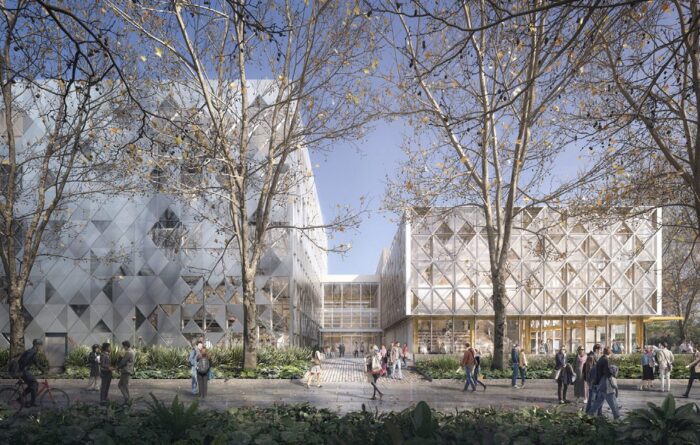
Macquarie University is building a dedicated multi-disciplinary building for engineering, astronomy and optics
Universities are built to shape the future, but we can’t claim to be leaders if we act like nothing’s changed. In an era of climate urgency, how we use space says everything about who we are.
In higher education, environmental responsibility isn’t a progressive stance: it’s the baseline. Institutions now measure carbon, set emissions targets, and embed sustainability into procurement and planning. But if reducing our environmental footprint is the obvious imperative, why is adaptive reuse, one of the fastest and most effective levers we have to lower carbon, still such a difficult decision?
The truth is, adaptive reuse isn’t just a design choice—it’s a test of values. It challenges us to rethink need, interrogate legacy, and confront assumptions about space, status and identity. It’s not just a major refurbishment; it demands that we look beyond a building’s current function and imagine entirely new possibilities.
This isn’t about stripping a structure back to its bones for a cosmetic refresh. Adaptive reuse requires the courage to engage with the complex, often uncomfortable task of redefining a building’s purpose—a true change of use to define a new value.
However, before we even ask whether it’s best to reuse or build anew, we must ask the harder question: Do we need to build at all? The most sustainable square meter is the one we never construct. And yet, most campus planning still begins with growth, not reduction.
Even when reuse is on the table, it’s rarely straightforward. Yes, the carbon savings are compelling. Buildings account for nearly 39 percent of global CO₂ emissions, including embodied carbon. While high-performance new buildings sound attractive, research shows it can take up to 80 years to offset the environmental footprint of construction. Adapting existing assets offers more immediate gains, but those gains come with compromises.
Adaptive reuse in a university context isn’t just a sustainability play but a strategic, often uncomfortable reckoning with space, legacy and future need. It demands clear-eyed evaluation and tough conversations about what to keep, what to change and what to let go. Just as importantly, it demands alignment with evolving educational models and research.
Today’s campuses are not simply physical locations. They’re flexible, hybrid ecosystems that must respond to digital learning, shifting enrollment and interdisciplinary collaboration. Adaptive reuse forces us to reconcile physical space with pedagogical ambition—and that’s a far more complex proposition than simply building new.
Reduce: Less Space, Better Use
Start with the most uncomfortable question: “Do we genuinely need all this space?”
Reusing a building that no longer meets program needs or enables outdated spatial models isn’t responsible adaptation. Sometimes, the smartest move is to reduce demand entirely, which means consolidating underused space, eliminating duplication and designing for more agile, communal behaviors. And this requires honest conversations.
Not every department needs its own floor, nor does every office need a name on the door. Traditionally, space is a proxy for status, which can lead to poor utilization when people become territorial.
Universities already have the data. Tools such as WiFi usage and swipe-card access can show real-time utilization rates. Leveraging this information can shift conversations from entitlement to evidence.
When we treat space as a shared resource rather than a fixed entitlement, we unlock opportunities for flexibility and collaboration that benefit the bottom line as well as the student experience. Responsible adaptation begins with the courage to reframe the conversation. After all, space isn’t an asset unless it’s being used well.
This shift toward data-driven reduction also creates new opportunities to build consensus. By illustrating just how infrequently certain areas are used or how poor layouts don’t support contemporary learning models, institutions can pave the way for rethinking space from the inside out—not as a matter of austerity, but as a path toward smarter, more student-centered environments.
There’s also an equity dimension to reduction that often goes unspoken. When prime real estate sits dormant while students crowd into overflowing classrooms, the issue isn’t square footage: it’s allocation. Data help leaders redistribute privilege more transparently, ensuring that resources follow need rather than tradition. In that sense, reducing space isn’t about shrinking ambition but about right-sizing opportunity.
Realign: Fit for Function
A common objection to reuse is a comment such as, “It won’t meet our technical needs.” And sometimes, that’s valid. Heritage buildings can struggle to accommodate labs or high-tech classrooms, and trying to force complex functions into ill-suited shells creates inefficiency and long-term frustration.
But what if we stopped asking what we could squeeze into the building and started asking what the building would be best suited to become?
Strategic realignment might involve moving specialist functions into new purpose-built spaces and dedicating adapted buildings to general teaching, collaboration or workplace use. It’s not about bending old buildings to fit modern programs; it’s about unlocking their best use within the broader portfolio.
That also means institutions must be willing to think holistically. Realignment is not a one-building exercise but a campus-wide strategy that calls for reshuffling, repurposing and sometimes retiring space altogether.
One example of adaptive reuse is Macquarie University’s new Engineering & Astronomy building, “part of a $150 million investment in the Science and Engineering Precinct,” according to the university’s website. The existing building had inefficient labs with a compromised servicing strategy due to low slab-to-slab heights. The resulting strategy was to relocate the engineering labs into a purpose-built extension and convert the existing lab into a workplace and dry labs—a much more appropriate use of the existing buildings.
Rather than relocating all the activity to the edge of campus, where there was a green field site for a large new building, the university was able to keep the energy and activation in the heart of the campus. Strategically locating specialist functions in the new extension and putting low-service activity in the existing building enables long-term growth and adaptability in maker space, workshops and engineering labs through purpose-built, efficient spaces.
Realignment also helps mitigate risk. When adaptive reuse is backed by a clear understanding of operational needs and building performance, it prevents misalignment that could lead to decades of frustration, inefficiency and renovation regret.
Beyond risk mitigation, realignment builds resilience so universities can pivot more quickly. Should enrollment patterns shift or a new discipline explode in popularity, the campus can reshuffle again without starting every conversation at the drafting table. In a sector defined by rapid change, that agility is priceless.
Reimagine: Honor the Past, Enable the Future
Responsible reuse doesn’t necessarily mean architectural nostalgia. It means surgical adaptation: knowing what to retain, what to strip back and what to rework entirely.
Great reuse projects respect character without being beholden to it. They introduce daylight, open up flow, remove clutter and modernize systems—the quiet, unglamorous work of making spaces functional again.
The University of Tasmania Forestry Building is a bold example of this approach. The heritage-listed structure is being transformed into an education and research hub, retaining 40 percent of its architecture while introducing Australia’s most extensive use of hempcrete and reinstating a living forest beneath its dome. The project respects legacy while creating a uniquely future-facing space for learning. Reuse can also deepen alumni connections and institutional memory. When done well, these buildings become more than carbon stories. They become living expressions of the university’s identity.


A very informative video about the engineering and construction of the University of Tasmania Forestry Building can be viewed at iimag.link/tsblz.
Reimagining space also allows institutions to revisit how architecture contributes to the learning experience. When done thoughtfully, adaptive reuse can catalyze pedagogical innovation, supporting more flexible, inclusive and tech-enabled environments.
It’s also an opportunity to interrogate what makes a space truly exceptional. Legacy doesn’t have to mean outdated. When done well, adaptive reuse can produce environments that feel grounded and visionary—places where past and future meet in service of learning—and that emotional resonance has lasting value. Students, faculty and alumni form deeper connections in places that carry history while inviting new possibilities. That kind of spatial storytelling strengthens the institution’s identity at every turn.
Let’s also not overlook the recruitment edge. Prospective students increasingly weigh sustainability credentials alongside program quality. A thoughtfully repurposed building that showcases circular design principles can become a talking point on every campus tour, signaling that the institution lives its values rather than marketing them.
Reevaluate: What Do We Really Value?
At its best, adaptive reuse reflects more than environmental stewardship. It expresses values: long-term thinking, cultural continuity and institutional courage. However, that only works when we’re honest about tradeoffs.
Reuse may not be cheaper. In some cases, it might take longer and may not deliver the same layout efficiency as a new build, which is why we need to revisit how we define value. What matters most in our triple bottom line? Is it the upfront cost, the operational footprint or the symbolic legacy? And over what timeframe do we measure success?
Monash University’s Net Zero Initiative is a case in point. While the university’s commitment to long-term carbon neutrality involves significant investments with delayed financial returns, it also reflects a values-led approach that builds trust and resilience into the institutional fabric. And the truth is, many adaptive reuse projects do cost less because they ultimately minimize demolition waste, reduce infrastructure pressure and utilize existing capital, while the costs that do arise often are linked to complexity, not indulgence. These costs must be weighed against a broader backdrop of impact: what’s saved in carbon, culture and continuity?
We also must consider the lived experience of the people inside these buildings, as a beautiful, highly efficient space nobody enjoys or uses is not a win. A reused building that serves its purpose and reinforces a community’s identity is far more valuable, even if it comes with architectural compromise.
It’s crucial to remember that, regarding adaptive reuse on campuses, value isn’t static. Instead, it shifts with context, timing and intention. That’s why reuse decisions require an evolved metrics system that captures long-term benefits, measures equity of experience and tracks not only what we spend but also what we stand to gain in cultural cohesion, stakeholder trust and educational quality.
Finally, reevaluation forces governance transparency. When boards and senates debate the merits of reuse in public, stakeholders witness the alignment or misalignment between stated principles and fiscal choices. That scrutiny is healthy, as it nudges decision-makers toward integrity.
The Real Question
So no, the question isn’t “Should we adapt or build new?” The real question is: “How do we make decisions about campus space that reflect who we are, what we stand for and the future we want to claim?”
Adaptive reuse isn’t easy, but neither is leadership. And in the era of climate urgency, responsible adaptation might be the most courageous step a university can take.

Gillies Hall, a new six-level, 150-bed residential accommodation complex on Monash University’s Peninsula campus is the first large-scale building in Australia to achieve Passive House certification. (Monash University)
Courage means more than taking action. It means acknowledging uncertainty, embracing complexity and making decisions that won’t always be universally popular. It means looking beyond metrics and into meaning. When universities choose to reuse not just for carbon but for character, not just for optics but for optimization, they model what it looks like to lead with integrity.
No solution is perfect, but responsible adaptation acknowledges this and moves forward regardless. It asks institutions to make informed tradeoffs that elevate mission over convenience and future impact over short-term gain.
That’s not just adaptive reuse. That’s adaptive leadership, and it’s precisely the kind of leadership the sector needs—not tomorrow, but today, because climate resilience, cultural continuity and institutional relevance won’t wait.
Reuse isn’t a delay tactic or a nostalgic gesture. It’s a future-forward strategy that demands vision, honesty and a collective willingness to do hard things well. When universities commit to responsible adaptation, they’re not just reshaping buildings—they’re reshaping what it means to be an anchor institution in an uncertain world.

About Caitlin Murray
Caitlin Murray is a strategy director and architect at ERA-co; email: Caitlin.Murray@era-co.com.