Country’s Largest Standalone Airport Terminal Set to Open at JFK
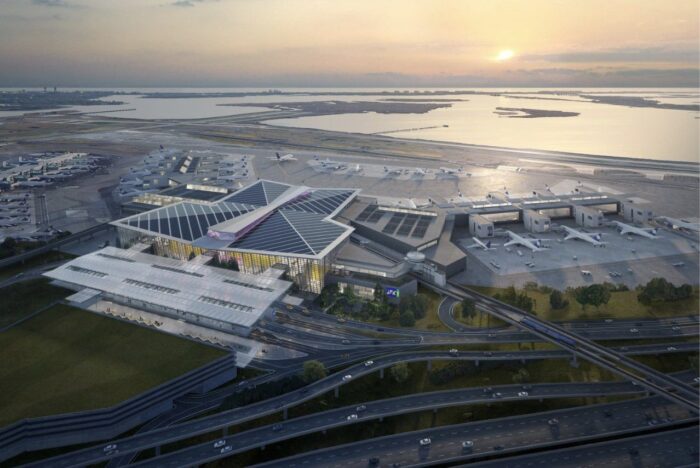
The 2.6-million-square-foot New Terminal One will be able to handle up to 20 million passengers per year when it opens fully in 2030. (Port Authority of New York and New Jersey)
The New Terminal One (NTO) at John F. Kennedy International Airport (JFK) will accentuate a series of major airport improvements in the New York metropolitan area when it opens its first phase in June 2026, applying modern design and technology to support the area’s growing passenger, sustainability and resilience demands.
The $9.5 billion project, the largest private-public partnership in the country, broke ground in September 2022 with a design-build team led by infrastructure firm AECOM Tishman and architecture, design and planning firm Gensler. In addition to the complexities of a phased demolition and construction process alongside ongoing airport operations at the existing Terminal 1, the project team also responded to a call to reduce its steel usage by almost 25 percent.
When completed in 2030, the 2.6-million-square-foot terminal will rank as the country’s largest standalone international terminal, according to the Port Authority of New York and New Jersey, which operates the airport. It will offer 23 gates and 300,000 square feet of retail space, complete with modern security-checkpoint technologies to modernize the curb-to-gate experience.
The project’s first phase, totaling 1.85 million square feet, will add 14 new widebody gates to the airport. When the first phase opens, airlines will move operations to the new gates, allowing for the demolition of the existing Terminal 1 and construction of NTO’s second and final phase. Because the airport’s financial projections rely on 19 operational gates, the team plans to expedite and first open five of the second phase’s nine gates in its own subphase.
The History of JFK International Airport
New York International Airport at Idlewild Field opened in 1948 with a single terminal and six runways. Serving New York’s transcontinental and transatlantic flights, the airport grew through a “terminal city” phase where it expanded to eight terminals—one dedicated to each airline—to its current configuration of four runways and five active terminals. The airport was renamed John F. Kennedy International Airport in 1963 following the assassination of President John F. Kennedy.
In 2013, the airport demolished Terminal 3, and in 2023 it demolished Terminal 2. It plans to demolish Terminal 7 following the completion of NTO’s first phase to make way for the new Terminal 6, a 1.2-million-square-foot, $4.2 billion terminal also scheduled to begin a phased opening in 2026. Terminal 5, which ceased operations in 2001, was repurposed in 2017 as part of the TWA Hotel.
When the current Terminal 1 opened in 1998, its 11 gates served fewer than 3 million passengers annually. Since then, demand has steadily approached design capacity, with the Port Authority reporting some 6.2 million passengers traveling through the terminal during the 12 months ending in June.
The airport as a whole marked its busiest year ever in 2024, having served 63.3 million passengers, a 2-percent increase over its previous record set in 2023. The Port Authority launched redevelopment initiatives totaling $30 billion across the agency’s four commercial airports: LaGuardia, Newark Liberty International and New York Stewart International in addition to JFK. LaGuardia opened its new Terminal B in 2020 and its new Terminal C in 2022. Newark Liberty opened its new Terminal A in 2023 with planning underway to replace its Terminal B and enhance Terminal C.
NTO alone will allow for 20 million passengers per year when complete, according to SBI Consultants, which provided cost engineering and schedule analysis for the project.
Aesthetic Architecture
NTO will welcome visitors approaching the arrivals curb with a 3.5-acre park before they reach the building’s ETFE high-performance plastic canopy and glazed façade. The 115-foot setback between the building and the roadway, originally established for security reasons and to accommodate the primary utility corridor, evolved during the design process beyond a simple buffer into a “welcoming landscape experience at the terminal’s front door,” explains Samantha Partington, project manager at OJB, which provided landscape architecture services for the project.
“Within this space, the design introduces layered plantings, walking paths and a variety of seating options that support both quick transitions and moments of pause for passengers, visitors and employees,” adds Partington.
The park’s large, bluestone outcroppings quarried from upstate New York will evoke the city’s Central Park and the region’s natural geology.
Inside, a central spine of skylights will let natural light into the airy, symmetrical main building while simultaneously guiding travelers deeper into the terminal toward the gates. Tree columns will support the gently sloped, 30-foot ceiling above the terminal’s two floors, which will carry in the locally inspired landscaping from outside.
“Within the grand, light-filled check-in hall, the landscape takes on a more refined character, drawing inspiration from New York City’s iconic plazas,” says Partington. “At its center, a series of landscaped plazas with sculptural marble planters and integrated seating provide a focal point for travelers before and after security.”

A 3.5-acre park at the terminal’s arrival curb will offer moments of pause to busy travelers. (OJB Landscape Architecture)
Rapid Digital Tooling
The airport’s intricate underground environment presented a unique stage for the new terminal as well as an opportunity for digital-modeling tools to shine.
“Our projects are becoming significantly more complex,” notes Mark Southwell, chief executive of AECOM’s global transportation design business, in a video describing the NTO project (iimag.link/RKUzG). “Using digital has allowed us to develop our methods of supporting clients and finding solutions in a more effective way.”
Networks of baggage tunnels and utilities crisscrossed the space under the build site.
According to AECOM Vice President of Global Aviation Navin N. Nitish, “From the outset of the project, we needed to understand and be able to navigate the underground space between existing Terminals 1 and 4, which is a complex environment, densely populated with existing utilities and characterized by its unique soil type, drainage, vegetation and topography. The potential for unforeseen conflicts in this environment was compounded by a lack of reliable underground utility information.”
AECOM created a computational tool to automatically convert 2D CAD drawings into a 3D model, allowing the design and construction teams to then compare the models with actual onsite conditions and decide what needed to be replaced or moved. A dynamic link between the drawings and Revit updated the 3D model in real time.
During fabrication, engineering firm Thornton Tomasetti employed its Advanced Project Delivery process, which allows the firm to complete steel-connection engineering inhouse. Once finished, it sends the resulting Tekla models directly to steel fabricators.
Whereas traditional jobs may rely on a fabricator to build models from drawings that then return to engineering for a round of review, Thornton Tomasetti sends true 3D models detailing every weld and bolt. The workflow reduces the number of change orders and improves the project’s cost certainty while allowing for faster turnarounds.
“Roughly every two weeks for 22 deliverables, we were sending out another piece of the building fully connected in Tekla,” says Thornton Tomasetti Principal John Barry. “So while the design team keeps running, we take the first piece, and we issue it, and that goes to the steel fabricator so they can start fabricating. They’re actually already erecting steel while we’re still finishing the last piece of the Tekla model.”
He estimated the workflow cut six to eight months from the overall process.
Similarly, OJB constantly compared the live state of the build site against their models, going as far as 3D scanning the boulders quarried for the park to update their models. These then were shared with the construction team to ensure their envisioned positioning would still work within the limited space.
“People will look back and say, ‘How did we do this before these digital tools?’ and that’s what excites me,” adds Southwell. “I think we’re at a real key point in our time where we’re really going to change this industry.”

A central spine of skylights over the main building will let in natural light and serve as a spatial reference for travelers.
A Steel Diet
When AECOM selected Thornton Tomasetti as the project’s structural engineer of record in early 2022, ownership had directed the team to attempt a reduction in the amount of steel used in the design.
“There was an ask from the owner to try to look at the whole structure—so they had completed schematic design—and find opportunities to reduce cost,” notes Barry. “The goal was to reduce 10,000 tons of steel from the project.”
The firm conducted a bottom-up review of the designs and succeeded in paring down the terminal’s 42,000 tons of steel to roughly 32,000 tons, almost a 25-percent reduction.
One major change, adds Barry, expanded the spacing of the tree columns supporting the terminal’s roof. While the original design had spaced the columns 30 feet apart on center, the updated design removed every other tree column, effectively moving the columns to sit 60 feet apart on center.
“The branches used to touch, but we just moved them out so they didn’t touch,” explains Barry. “You still have the same number of supports of all the girders.”
Within the structure’s lateral system, additional brace frames to the roof and mechanical shafts helped reduce the demand on the tree columns.
“In general, we went over all the loading in the entire structure, removed floor fill where it wasn’t necessary anymore to try to reduce the buildups of the floors (and) get the load down,” he says. “That way, we could be more efficient in the floor framing.”
Among other modifications, the team redesigned a central v-column holding up the roof in the TSA area into two v-columns, improving the flow of passenger queues through the area while also cutting down on the number of roof spans used.
Sustainability and Resilience
Located on the northeastern shore of Jamaica Bay in Queens, JFK sits at an elevation of 13 feet above mean sea level, which itself has risen some 8 inches since 1970, according to the Earth Information Center. Projections (assuming an intermediate trajectory for global temperatures) estimate the sea level there will rise by another 11 inches by 2050, with a 5-percent chance they will exceed this prediction.
To add to the problem, a study of vertical land motion in the New York area between 2016 and 2023 revealed an average subsidence rate of about 0.063 inches per year, totaling more than 1.5 inches by 2050 (iimag.link/msZfF).
According to Barry, the team designed the building for a 100-year flood plus an additional 2 feet of sea-level rise, which works out to about a 500-year-flood design level.
While the terminal sits at 14 feet 6 inches elevation at its perimeter, the building interior will go down to about 10 feet elevation, with any water held out with concrete walls along the perimeter and a pressure slab to counter the hydrostatic uplift. The terminal’s baggage-handling tunnels already sit below the water table and require tie downs to keep them from floating up.
NTO’s roof will support an array of 13,000 solar panels, covering an area of more than six football fields and ranking as the largest array in New York City when complete. The panels will generate up to 6.6 megawatts of power, part of the terminal’s 12-megawatt microgrid that—with a combination of solar, fuel cells, battery storage and other generation infrastructure—can operate either independently of or connected to the main power grid.
Other sustainable design strategies such as daylighting through tinted glass and rainwater catchment on the roof will support the terminal’s LEED Silver certification, according to Gensler.

The design team looked at the spacing of the terminal’s tree columns in its attempt to reduce the project’s steel usage. (Bess Adler/Thornton Tomasetti)

The central spine during construction. (Bess Adler/Thornton Tomasetti)
State of the Art TSA
In addition to undisclosed protective design measures built into the terminal, its security will support the TSA’s new credential authentication technology system (CAT-2), which uses facial recognition to efficiently verify traveler identities. The new security checkpoints will also replace traditional x-ray baggage scanners with computed tomography scanners that produce high-resolution, 3D images and reduce the need for manual bag checks. Advanced millimeter-wave body scanners will screen multiple travelers simultaneously for objects within their clothing.

About David Jen
David Jen is a freelance science journalist based in the San Francisco Bay Area. Learn more about him at www.davidjen.com or follow him on Twitter @djenwrites.