Analyzing FRP’s Cost and Success in the Egyptian Theater Seismic-Retrofit Project
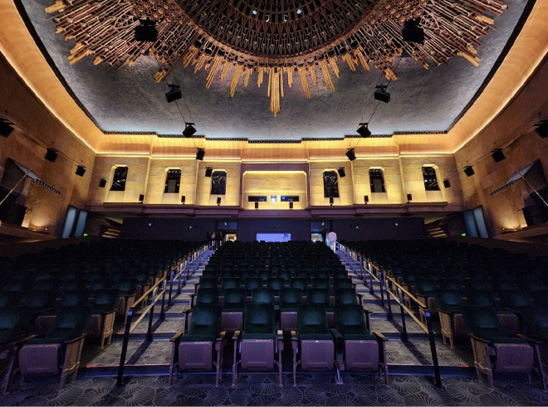

The Egyptian Theater was built in 1922, and its retrofit hoped to preserve as much of its history and aesthetic as possible while making it safe for a seismic event.
The design-build field has continued to evolve and, as a result, various methods prove available to help engineers develop solutions to meet critical design criteria in an economically viable fashion. If the cost to produce the solution exceeds the budget, the engineer returns to the proverbial drawing board.
A wave of interest surrounded the recent seismic retrofit project at the famous Egyptian Theater in Los Angeles. A change in the local building codes dictates that concrete buildings must be equipped with a seismic retrofit solution due to potential earthquake damage, and the Egyptian Theater’s concrete design fell within the new regulations. With a building of its age and unique design, a challenge surfaced in how to meet the regulation’s parameters while accounting for critical structural facets such as weight, load and sheer.
“Analysis showed the theater didn’t have the capacity to stay stable under a seismic event of at least the magnitude we were designing it to withstand,” explains Jonathan Lehmer, structural engineer at Structural Focus, the structural engineer of record for the Egyptian Theater project. “There was a previous retrofit in the theater after the Northridge Earthquake in 1994, but it was limited and wasn’t a full-code seismic upgrade.”
According to Lehmer, the growing technology of fiber-reinforced polymers (FRPs) became the design’s critical load-carrying solution. FRP is an applied solution that provides tensile strength and stiffness while remaining resilient by resisting corroson. It additionally transfers load and protects fibers from deterioration.
“Structural Focus specified where FRP would be used and established the design criteria,” says Lehmer. “We used Simpson Strong Tie as a subcontractor, who took our structural drawings and designed the FRP application to meet those requirements.”
The FRP design primarily applied to the existing concrete columns found throughout the theater that date back to the 1920s. To meet retrofit requirements, they had to be fully wrapped with FRP. The application, however, didn’t stop there. During the previous retrofit, additional concrete walls were added. FRP was added to these existing walls as well as other building components.

A graphic describes the basics of fiber-reinforced polymer (FRP) composites, including an installation crew mixing and
applying a strong resin between layers to strengthen structural members as specified in plans and specifications.
Analyzing Costs and Outcome
According to Lehmer, FRP use wasn’t limited to the columns. The structural design inspired FRP use on concrete walls added during the previous retrofit to add considerable strength to those walls. In addition, the technology was used for miscellaneous gravity strengthening.
“We had to use FRP for seismic retrofit strengthening, but there were various areas of the theater that also needed to be strengthened,” adds Lehmer. “We had to strengthen roof beams for new mechanical units that were to be located on the roof so they could carry the additional loads. We elected to utilize FRP for those.”
FRP is a lighter-weight strengthening solution, a major factor when additional loading is a concern.


In addition to strengthening columns and walls, Structural Focus designed a rooftop weight-carrying solution with FRP that allowed for the use of additional mechanical equipment.
“We’re in a way hurting ourselves by increasing the seismic demands on the building with added weight, so we try to keep that weight as low as possible, and FRP proves to be a great option for that,” explains Lehmer.
In many cases, an alternate or innovative technology can negatively impact budget restraints. While FRP’s lightweight capacity was useful in the theater, it also proved economically viable, as alternate solutions of more commonly used practices exceeded weight and economic restraints in parallel.
A telling example was found with the theater’s roof. To meet code requirements and provide the support demanded, the supply of steel needed to produce a load-carrying solution would have far surpassed the costs associated with using FRP. Looking past the structural component itself, the added labor needed in support services would have added to those increased costs. There would be crane costs to offload steel members at the construction site and transfer them into the building’s load locations as well as the manpower to make welds and complete bolt-up scenarios.

A graphic illustrates the massive quantity of concrete used in the Egyptian Theater. With the use of FRP, it was strengthened to meet modern building codes and withstand a specific range of seismic events.
Installation of FRP requires specific training and certification programs to ensure installers are trained to correctly install the product, but the need for various support-service features isn’t as evident in the FRP application process. In a compounding effect, Lehmer identified that the more components were strengthened with steel and concrete, the more weight was added to the overall structure. As that weight increased, the foundation would need to be strengthened to carry the additional pressure.
“You can really start chasing your tail, and the cost competitiveness of the FRP prevented that,” notes Lehmer.

FRP was applied to massive wall sections to increase strength and withstand seismic loads in a Risk III category.
The weight factor also penetrated potential success when managing existing concrete columns. To extract the strength needed, additional concrete and steel would’ve been the solution if FRP wasn’t viable, and such an application would need additional personnel and equipment for implementation. The FRP application process also proved much faster than other solutions.
“FRP is much easier to install in the field,” says Lehmer. “The lightweight carbon-fiber fabric rolls can be carried up on the roof and saturated in epoxy, and it’s rolled out and laid down; whereas steel would have needed crane support and other activity like shutting down the road.”
Although it was established that part of FRP’s economic success stems from a decrease in the need for support services, the time-management sequence plays an additional role. Looking at concrete and steel as the more-conventional alternative to carry massive weight demands, the element of time suffers.
Although using concrete results in the ability to carry significant weight, the cure time influences progress. If columns would’ve been expanded in size with concrete, the cure time would delay the increased load capacities; using FRP to strengthen columns allowed for faster forward progress, and saving time in a construction project saves money.

Theater columns also were reinforced with FRP to increase load capacity
Determining FRP’s Place in the Design Chain
As with any design solution, FRP can be strategically specified and designed by the engineer of record for the project, or it can be required to specify in the structural design, and a subcontractor would create the design to meet the engineer’s specifications.
According to Lehmer, Structural Focus specified the use of FRP in certain areas of the Egyptian Theater seismic retrofit design, and Simpson Strong Tie designed the system to meet engineering specifications. This typical process is a deferred submittal or a design-build item.
“In our drawings, we do not specify the exact number of layers or the layout of the FRP,” notes Lehmer. “We specified where it is needed and then a company, Simpson Strong Tie in this case, creates a design and submits a bid for the project. The FRP went to open bid, and Simpson was selected through the general contractor.”
The process of making specifications and allowing a subcontractor to provide a design to meet those standards is nothing new. The residential construction sector often uses that in areas such as flooring and roofing systems.
“It is a very similar process,” says Lehmer. “The engineer would specify the loads, and then the manufacturer or supplier of a system would create a design to meet those loads. That design would still be reviewed to ensure it would be effective.”
So when it comes to where the FRP application should land in the design-creation process, Lehmer identifies the driving force as determining who has the latest research and knows more about the product and its application. Because FRP is innovative technology, Lehmer sees more reliance on the design-build process. By relying on companies who manufacture and supply FRP, Lehmer feels assured the latest research and technology is utilized for the process at hand to effectively meet the requirements instituted by the structural engineer.

Before the FRP was applied to multiple load-carrying members and shear walls, it was subjected to
detailed testing to ensure performance success.
Summarizing Success with Caution
Lehmer credits FRP with great emphasis when measuring the success of the seismic retrofit for the Egyptian Theater. With multiple load-carrying aspects needing to be engineered, FRP added to the overall success of the design and its implementation.
In many aspects, Lehmer says an FRP solution might not be warranted if it can’t be used to satisfy multiple aspects of load rework. Where it’s appliable, however, weight capacities can be met at competitive pricing with the FRP solution while saving costs in reduced labor needs and avoided specialty support services. Project success is built upon a compounding use of best building practices and methods while keeping strict cost management. FRP allows this practice to take place.
With the good FRP provides, Lehmer identified the need to ensure this solution is best suited for the project for which it’s being considered. While it offered a high success rate overall for the Egyptian Theater retrofit, that doesn’t make it the best solution for all projects and designs.


FRP installers utilized resin and fabric to apply layering for added strength to structural support members
“Keep in mind that you can only get so much capacity out of a certain component no matter how much FRP you add to them,” cautions Lehmer.
While FRP provided the capacity needed at the Egyptian Theater, Lehmer points out that it might not produce the same results elsewhere; it depends on the specific features of each project. Additionally, while research on FRP systems continues to evolve, Lehmer notes the importance of due diligence in making sure the latest information is reviewed to ensure FRP is the right fit while designing a load-carrying system.
“FRP offers a viable solution in the right instance,” notes Lehmer. “It is not a miracle worker though. Careful consideration should be given to assess capacity limitations, and the most-recent research should always be reviewed.”
For more information on the Egyptian Theater retrofit project, watch the Informed Infrastructure webcast that inspired this article by visiting iimag.link/EsMwj. AIA-accredited LU/PDH hours are available for webcast attendees.

About Nick Vaccaro
Nick Vaccaro is a freelance writer and consultant who serves the energy and construction sectors; email: nav@vaccarogroupllc.com.