When Routine Maintenance Finds Major Problems: Charleston Water System Turns Near Disaster into Opportunity
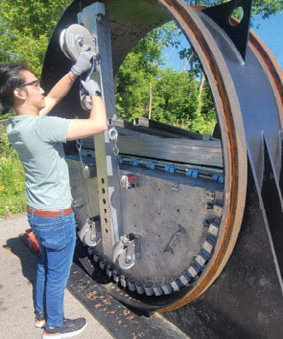
Because each half of the foldable isolation plug assembly weighed about 900 pounds, designers ended up installing manual cranks that could be used by divers when assembling. This photo was taken at the Petersen Products yard, where the dive team worked with designers to troubleshoot assembly procedure
The Charleston Water System (CWS) Hanahan Water Treatment Plant set out to perform a normally routine maintenance task—take one 5-million-gallon clearwell (an approximately 220-foot-diameter by 20-foot-deep tank) offline to replace a baffle curtain. But when the clearwell proved impossible to dewater safely due to the failure of 84-inch butterfly valves, engineers and managers were suddenly confronted with substantial risks to millions of dollars in infrastructure investment, not to mention staff and contractors. Experienced civil engineers, expert designers and fabricators, and highly specialized subcontractors were quickly assembled, and this team of infrastructure all-stars was able to engineer, design, build and install a highly innovative bespoke solution within a few weeks.
The result—from the utility’s point of view—is a fully restored clearwell with improved hydraulics, proven contingency tools for future maintenance and a repeatable owner-led model for solving nonstandard isolation issues in critical potable-water-delivery infrastructure.

The folded mechanical stop assembly being craned via Clearwell 3’s cramped access hatch. Each assembly weighed nearly a ton.
System Context
CWS is the region’s public water and wastewater utility, operating the Hanahan Water Treatment Plant for potable supply and the Plum Island facility for wastewater treatment—under a mission to support public health and protect the environment—with governance by elected commissioners. Hanahan treats surface water from Bushy Park Reservoir and South Carolina’s Edisto River (the longest free-flowing blackwater river in North America) via sedimentation, filtration and disinfection; and then stores finished water in clearwells that provide critical contact time and operational flexibility before high-service pumping sends water into the 1,800-mile distribution system.
A rolling and well-funded capital-improvements program is currently focused on expanding Hanahan’s capacity to 127.4 million gallons per day, adding a third trunk feed to the peninsula, and renewing wastewater tunnels and pump stations to improve system resilience. The work described in this case study proved to be an effective way to expand capacity and improve resilience.
Simple Maintenance Job Turns Complex
Clearwells require periodic curtain replacement to maintain disinfection contact time, and CWS scheduled Clearwell 3 for a routine curtain renewal, paired with construction of a concrete baffle wall to withstand jet forces and mitigate future curtain damage, and this work required a completely dry tank for possibly months. During prework checks, the 84-inch butterfly valves serving the influent and effluent were found to leak significantly; despite diver-assisted attempts to improve the shut by shaving valve seats, leakage was far beyond what practical bypass pumping could handle continuously and safely for the duration of construction.
CWS’s Plant Engineer James Wilson summarized the impasse: “The leak-by from the valves was significant—so much so that temporary pumps couldn’t realistically keep up,” making a conventional dewatering plan neither economical nor tenable for a dry, safe work zone inside the clearwell.

When folded and with wheels attached, divers could transport the nearly 1-ton mechanical plug assemblies with relative ease, even through 45-degree pipe bends, and when air hoses and communication lines constrained access.
Engineering Strategy Led by Owner’s Advisor
Black & Veatch, CWS’s planning and engineering partners, were engaged to lead a design-level solution for isolation rather than delegating it entirely to construction means and methods, an atypical but appropriate choice given the safety risks and the live water-quality environment.
“This one came down to engineers working out a method that we could sign off on,” explains Black & Veatch Project Engineer Charles “Chip” Hall, noting that an 84-inch buried pipe subjected to deadhead loading requires certainty on restraint and materials that record drawings alone couldn’t provide—especially for two-decade-old work. Hunter Stewart, P.E., Black & Veatch’s project engineering manager, recognized that detailed dive measurements were needed to identify and describe a continuous, welded steel section—about 30 feet downstream of a valve—that could safely bear the isolation solution’s hoop loading without risk of joint separation or damage to less-robust composite pipe segments.
Selecting a Mechanical Plug with Inflatable Seal
With dive survey data in hand, Black & Veatch canvassed large-diameter isolation options and connected with Petersen Products—frequently referenced inside the multinational, consulting firm for unusual plug and seal applications—to develop a semi-mechanical, semi-inflatable plug that could be folded, transported through an access hatch, rolled hundreds of feet inside an 84-inch pipe, unfolded and then sealed with an inflatable annulus ring for months-long service in potable water.
Family owned since 1916, Wisconsin-based Petersen Products (PetersenProducts.com) designs and fabricates custom inflatable and mechanical line stops for industrial and civil applications globally.
A more-commonly used all-inflatable test plug was deemed insufficient for hold time and pressure uncertainty; the team instead specified a mechanical body with jacking bolts to seat the plug as well as a compliant, replaceable EPDM synthetic-rubber sealing bladder after early Kevlar concepts proved difficult for divers to handle in shop trials. And Stewart identified the performance criteria that CWS required as owner: installation constraints, potable contact compliance via NSF-certified coatings and safety factors commensurate with potential deadhead loads that could reach the equivalent of an “18 wheeler” pushing on the plug face in an 84-inch pipe.
Why Isolation Mattered
From CWS’s point of view, safe, verifiable isolation wasn’t just about construction access; it was about protecting finished water quality and maintaining system reliability while major capital work proceeded at an active plant.
CWS balances growth-driven capacity, regulatory compliance and asset renewal—expanding Hanahan and reinforcing transmission to the peninsula—so an isolation failure could have had outsized impacts on service and trust, especially amid broader expansion communications reported by local media in 2022 and 2025 that highlighted the escalation of investment to meet future demand. As the local CBS affiliate phrased it in a recent segment on CWS expansion, the utility is upgrading “to meet future demand,” underlining the stakes for reliability during complex maintenance in the meantime.

Installed isolation plugs maintained seal without incident for nearly six months.
Lessons From the Shop Floor
CWS’s decision to support full-scale dry-fit trials at Petersen’s facility—bringing divers, engineers and plant stakeholders together—proved decisive for field safety and project success by revealing impractical elements early as well as enabling fast redesigns of the transport and jacking systems before mobilization.
“It was like walking into a ‘MythBusters’ set,” says John Lares, Salmons Dredging’s topside dive supervisor, praising rapid iterations that simplified installation and reduced diver risk inside a confined 84-inch pipe with two 900-pound plug halves occupying half the diameter during insertion. Hall notes that conservative, layered safety factors from engineers and manufacturers initially produced test rigs so strong they deformed steel mockups, prompting a rational rebalancing to the real operating envelope—an example of collaborative, data-driven risk management before underwater field work at Hanahan.
Divers In Drinking Water
CWS has used commercial divers before, notably in major tunnel and conveyance programs publicized in 2021 and beyond, so deploying a seasoned in-plant dive team for clearwell work aligned with established practices at the utility. For Clearwell 3, divers worked in disinfected potable water using sterilized dry suits and surface-supplied Nitrox to extend bottom times, with helmet cameras feeding a topside supervisor trailer where engineers could request measurements and adjust tactics in real time while maintaining water-quality protections.
Entry was through a roof hatch on the partially buried clearwell, with plugs craned to the deck, lowered inside and guided to the pipe openings; divers then rolled each folded plug hundreds of feet to the validated steel section, unfolded it with a ratchet-and-pulley system, torqued jacking bolts in sequence to a specified 190 feet pounds, and inflated the annular ring bladder to a remotely monitored controlled pressure.
Precision, Patience, Safety
Despite the “cave-diving” geometry of long, curving pipe runs and a 14-foot drop to reach the pipe’s springlines, Salmons Dredging’s team completed both influent and effluent installations in about 13 days onsite (including interior pipe cleaning for smooth rolling), later removing the plugs in five days at project closeout, all without incident.
“Once you get a 1,800-pound half-plug into an 84-inch pipe, you have to maintain 100-percent control of its attitude,” adds Lares, describing carefully rigged snatch blocks, magnet anchors, and in-water tending to keep lines and umbilicals safe during unfolding and inflation against a slow but constant leak-by head. Wilson confirmed that flows past the valves were gravity-driven and modest from a diver-workload perspective, but the sustained hold requirement—about months months of isolation—made reliable sealing and continuous pressure monitoring essential.
Contractor Delivery Under Pressure
M. B. Kahn served as general contractor for the clearwell interior work, coordinating with Precon (baffle curtain engineering and performance spec delivery) under an owner-led isolation plan that handed off a dry, stable work zone to expedite construction while preserving plant operations and water quality.
The general contractor’s experience with complex water-treatment upgrades in Charleston—including filtration, chemical storage, sludge handling and electrical/instrumentation scopes—aligned with the tight sequencing, access limits and quality controls inherent in clearwell construction at an operating facility. That pragmatic pairing—owner-verified isolation and an experienced builder—translated initial engineering uncertainty into project success.
Black & Veatch’s Engineering Stewardship
Black & Veatch’s role extended from long-range master planning to hands-on problem solving in a cramped, high-risk space: verifying restraint, specifying performance requirements, orchestrating submittal cycles and shop trials, and mediating conservative safety factors into workable test and field criteria that teams could execute.
“It was impressive how seamlessly the installation went in the field,” adds Stewart, crediting the shared visuals and full-scale rehearsals for making a nonstandard task go smoothly in practice. Hall underscored that alternative options such as line stops with large excavations were cost-prohibitive and riskier at this diameter and depth compared to a tailored in-pipe solution. The experience also reframed the typical “contractor means and methods” assumption: in some live-water contexts, owners and their engineers must own the isolation design to de-risk construction and protect public health.
Dive Team Expertise a Force Multiplier
Salmons Dredging’s inland diving group brought decades of potable and wastewater experience with CWS, including formal standards established by the Association of Diving Contractors International that dictated in-water tending and team composition at turns greater than 45 degrees, translating to three divers in for the longer influent run and two for the shorter effluent segment.
Average bottom times in sterilized dry suits neared four hours; live comms and methodical pre-dive briefings built a predictable operational cadence; and Nitrox was used to extend work windows and reduce decompression risk while topside supervisors monitored video, bladder pressures and instrumentation to verify hold performance over the entire isolation period.
CWS’s broader program history with underwater work—including tunnel repairs and replacements publicized in 2021—meant the utility was culturally prepared to integrate dive operations into capital delivery safely and effectively.

Hanahan’s Clearwell 3 is partially submerged, somewhat obscuring its massive, 5-million-gallon volume.
Owner Outcomes and Permanent Improvements
For CWS, the project achieved three core objectives: 1) complete dewatering for safe construction, 2) installation of a robust concrete baffle wall to protect curtains from jet forces and 3) replacement of the baffle curtain to restore certified contact time performance at higher plant flows, all while maintaining system service.
“Very successful,” notes Wilson, adding that the now-proven Petersen plugs are stored for likely reuse to isolate Clearwell 4 during its upcoming maintenance cycle. This will require minor dimensional checks due to slight deflections sometimes observed in spiral-welded steel under ground pressure when drained.
The ability to reuse owner-funded isolation tooling supports CWS’s asset-management philosophy—upfront investment lowering risk and lifecycle cost for future work—and is consistent with the utility’s capital-program approach to capacity, reliability and regulatory compliance. All in all, this routine water-treatment plant maintenance task ended up being an exciting win for every stakeholder.

About Angus Stocking
Angus Stocking is a former licensed land surveyor who has been writing about infrastructure since 2002 and is the producer and host of “Everything is Somewhere,” a podcast covering geospatial topics. Articles have appeared in most major industry trade journals, including CE News, The American Surveyor, Public Works, Roads & Bridges, US Water News, and several dozen more.