Trends June 2024
ASCE Report: Continued Federal Infrastructure Investments Will Save Jobs and Grow the Economy

Recent federal legislation addressing the nation’s rapidly accelerating infrastructure needs, including the Infrastructure Investment and Jobs Act (IIJA) and Inflation Reduction Act (IRA), will save American families an average of nearly $700 per year and save U.S. industries more than $1 trillion in gross output, including $637 billion in savings to GDP, if these newly established funding levels are maintained through 2033, according to “Bridging the Gap,” a new economic study from the American Society of Civil Engineers (ASCE) released in May 2024.
The report analyzes two possible scenarios over 10- and 20-year timeframes: one in which recent federal spending levels remain in place, referred to as the “Continuing to Act” scenario, and the other in which federal infrastructure investment returns to pre-IIJA levels when the bills expire in 2026, or the “Snapback” scenario. The report finds that Continuing to Act greatly reduces infrastructure inefficiencies through time, leading to additional industrial output and household disposable income; however, reverting to pre-IIJA levels, or “Snapback,” will have a cascading effect on the economy, reducing disposable income for families, and hampering business productivity and overall GDP year after year.
The report cites marked improvements from ASCE’s last economic report, “Failure to Act,” which was issued in 2021—prior to IIJA—and estimated households lose $3,300 per year due to faulty infrastructure. However, according to the report, the federal government alone can’t solve this problem that was decades in the making. State and local governments, in addition to the private sector, must prioritize infrastructure to further reduce costs to households.
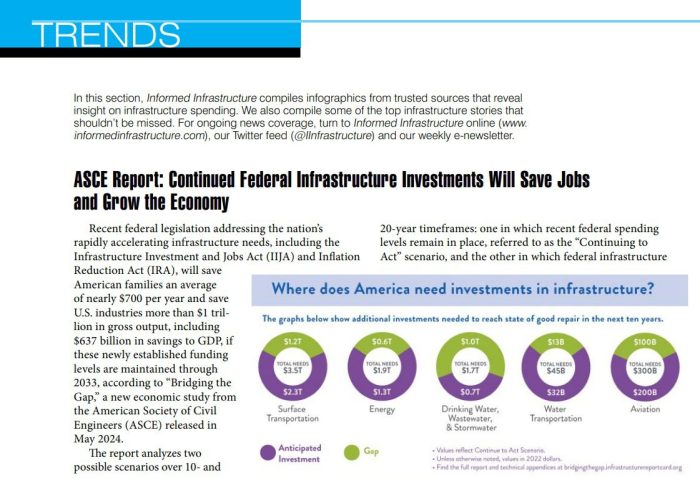
Between now and 2033, the ASCE report estimates that nearly $7.4 trillion is needed across 11 infrastructure areas: highways, bridges, rail, transit, drinking water, stormwater, wastewater, electricity, airports, seaports and inland waterways. Under the Continuing to Act scenario, approximately $4.5 trillion in investment is anticipated, which covers approximately 60 percent of total needs, leaving a gap of $2.9 trillion. Under the Snapback scenario, $3.7 trillion in investment is anticipated, which covers less than 50 percent of total needs and leaves a gap of more than $3.7 trillion by 2033.
View the full report at bridgingthegap.infrastructurereportcard.org.
EPA Survey: U.S. Needs Dramatically Increased Funding for Wastewater and Stormwater Systems
In April 2024, the Enviornmental Protection Agency (EPA) released to Congress its “Clean Watersheds Needs Survey,” which estimates the total cost of investments needed in each state and territory for wastewater treatment plants, stormwater, pollution control and septic tanks.
Last updated in 2012, the survey is meant to help the federal government and states determine potential gaps between water infrastructure needs and available funding. It’s also intended to identify steps states must take to meet their water-quality goals under the Clean Water Act.
According to the report, the nation’s total reported needs for clean water infrastructure are $630.1 billion, a 77 percent increase from the 2012 edition and likely an underestimation of the true amount needed. Read the full report and all its details at bit.ly/4atDLd0.
45th Annual A&E Study Reveals Industry Stability and Optimism
The recently released 45th annual “Deltek Clarity Architecture & Engineering Industry Study,” based on a survey of more than 650 A&E firms of all sizes in the United States and Canada, delivers industry-specific key performance indicators, identifies key challenges impacting the industry, highlights bright spots and forecasts future trends.
The latest report shows that firms effectively navigated economic uncertainties and rising costs to achieve healthy, although essentially flat, operating profit margins year-over-year. Reaching that steady state, relative to the volatility firms experienced in the last few years, enabled A&E leaders to focus on driving operational efficiencies, staff utilization and exploring technology to provide an additional edge.
Key findings from the report include:
• Win rates are stable, and firms are cautiously optimistic about growth, but balancing that with decreasing proposal value.
• Use of AI-powered tools is gradually increasing across firms of all sizes, but there’s an urgent need for targeted educational opportunities and support for employees to see benefits from this technology.
• Finding a balance between cost containment and investment to enhance project performance is paying off.
• Firms are focusing on leveraging existing workforces to their fullest extent to pursue operational efficiencies and improve cost-effectiveness.
Access the full report at bit.ly/3QOXixt.
U.S. Government Proposes 10 ‘National Interest’ Transmission Corridors
 In May 2024, the U.S. Department of Energy (DOE) proposed 10 National Interest Electric Transmission Corridors (NIETC), as shown in the accompanying image, and is accepting public comment on the potential NIETCs.
An NIETC is an area of the country where DOE determined the lack of adequate transmission harms consumers and development of new transmission would advance important national interests in that area, such as increased reliability and reduced consumer costs. In addition, NIETC designation can unlock federal financing tools.
To learn more and offer comment on the proposed corridors, visit bit.ly/3UGoRud.
TOP Stories
The following are the top stories from the last few months (in terms of traffic) on the Informed Infrastructure website. This also reflects key coverage areas that are regularly refreshed online and via our weekly e-newsletter. Simply search key words on Informed Infrastructure online to find the full story.
Buildings
- 3D Printed Nanocellulose Upscaled for Green Architectural Applications
- New Mexico Strengthens Building Safety and Sustainability by Adopting International Energy Conservation Code
- American Concrete Institute Publishes Design Handbook and Recommended Guidelines for Nonmetallic Reinforcement
- Report: Engineering Materials for a Sustainable Future
- Ground Screws Pioneering Sustainable Foundations in Modern Construction
Transportation
- Acrow Bridge Installed to Carry Detoured Traffic During U.S. Highway Upgrades in Rural Oklahoma
- Road Features That Predict Crash Sites Identified in New Machine-Learning Model
- New ARTBA Website is Hub for Infrastructure Law and Transportation Policy
- New Interstate Bridge Replacement Visualizations Available
- Video: Preservation Through Partnerships: The Messerall Bridge
Water
- Woolpert Awarded $5.4M Contract to Provide Stormwater Management, Compliance Support for SCDOT Statewide
- Video: Explore the Risk of PFAS in Local Tap Water
- Atlanta DWM Moves Forward with Project to Increase Sewer Capacity and Mitigate Flooding
- NIBS Issues Report on Access to Clean Water and Sanitation
- New Pacific Institute Report Finds Substantial Opportunity for Urban Stormwater Capture to Enhance Water Resilience in Communities Across the United States
Tools and Technology
- Vectorworks 2024 Update 3 Blooming with Possibilities for Designers
- HCSS Highlights HeavyBid for Heavy Construction Bidding and Estimating
- The First Digital Twin of Earth in 3D, Time-Dynamic and Cloud-Free
- IMAGINiT Technologies Offers New Self-Paced Training for Autodesk and Spatial Business Systems Software
- Autodesk Informed Design Unlocks Industrialized Construction to Connect Design and Make Workflows