Trends August 2024
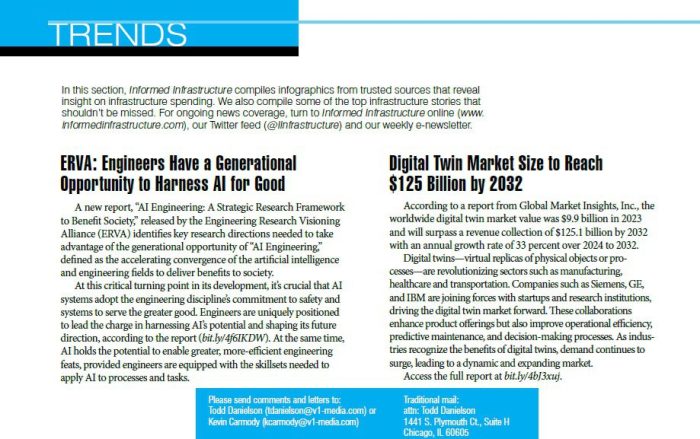
ERVA: Engineers Have a Generational Opportunity to Harness AI for Good
A new report, “AI Engineering: A Strategic Research Framework to Benefit Society,” released by the Engineering Research Visioning Alliance (ERVA) identifies key research directions needed to take advantage of the generational opportunity of “AI Engineering,” defined as the accelerating convergence of the artificial intelligence and engineering fields to deliver benefits to society.
At this critical turning point in its development, it’s crucial that AI systems adopt the engineering discipline’s commitment to safety and systems to serve the greater good. Engineers are uniquely positioned to lead the charge in harnessing AI’s potential and shaping its future direction, according to the report (bit.ly/4f6IKDW). At the same time, AI holds the potential to enable greater, more-efficient engineering feats, provided engineers are equipped with the skillsets needed to apply AI to processes and tasks.
Digital Twin Market Size to Reach $125 Billion by 2032
According to a report from Global Market Insights, Inc., the worldwide digital twin market value was $9.9 billion in 2023 and will surpass a revenue collection of $125.1 billion by 2032 with an annual growth rate of 33 percent over 2024 to 2032.
Digital twins—virtual replicas of physical objects or processes—are revolutionizing sectors such as manufacturing, healthcare and transportation. Companies such as Siemens, GE, and IBM are joining forces with startups and research institutions, driving the digital twin market forward. These collaborations enhance product offerings but also improve operational efficiency, predictive maintenance, and decision-making processes. As industries recognize the benefits of digital twins, demand continues to surge, leading to a dynamic and expanding market.
Access the full report at bit.ly/4bJ3xuj.
EPA Report: More Than $630 Billion Needed for Wastewater, Stormwater During Next 20 Years
The U.S. Environmental Protection Agency (EPA) recently transmitted a report to Congress outlining clean water infrastructure investments needed over the next 20 years, including wastewater and stormwater system upgrades.
Through the Clean Watersheds Needs Survey (www.epa.gov/cwns), states and U.S. territories report on future capital costs or investment needs to maintain and modernize publicly owned wastewater treatment works, stormwater infrastructure, nonpoint source control and decentralized wastewater treatment systems such as septic tanks.
The 2022 survey represents the most recent comprehensive and robust report on wastewater, stormwater and other clean water infrastructure needs in the United States, and it shows that at least $630 billion will be needed during the next 20 years to protect our nation’s waterbodies. The National Association of Clean Water Agencies said this represents a 73 percent increase in total reported needs since the previous 2012 report a decade ago.

On May 28, 2024, the Federal Transit Administration (FTA) issued $343 million in grants to eight transit systems in eight states to help fund a variety of rail improvements.
That grant funding, issued via the FTA’s All Stations Accessibility Program (ASAP), aims to help make rail stations more accessible in line with the Americans with Disabilities Act (ADA) standards by installing elevators, renovating platforms for level boarding, improving signage and enhancing visual and audio systems.
According to the FTA, inaccessibility is a significant hurdle for riders using “legacy” rail systems built before 1990, noting that more than 900 transit legacy stations are not fully accessible today.
Two projects overseen by state departments of transportations received grants from this round of ASAP funding:
• The Massachusetts Bay Transportation Authority will receive $67 million to upgrade station platforms at 14 stops along the Green Line’s light rail B and C branches that are not accessible to riders with disabilities. Improvements will focus on improving safety, including installing accessible platforms for level boarding.
• The Maryland Transit Administration will receive about $1.3 million to conduct engineering and design work to make the College Park Maryland Area Rail Commuter or MARC station on the Camden Line fully accessible. That work will allow riders to easily board and depart from the station using new 600-foot, low-level platforms. That project will also add safety protections in and around the station that will directly meet the needs of passengers with disabilities.
TOP Stories
The following are the top stories from the last few months (in terms of traffic) on the Informed Infrastructure website. This also reflects key coverage areas that are regularly refreshed online and via our weekly e-newsletter. Simply search key words on Informed Infrastructure online to find the full story.
Buildings
- Federal Advisory Council on Historic Preservation Incorporates International Existing Building Code into Housing Policy Statement
- AISC Releases New Version of Certification Standard (AISC 207-23)
- Second Edition AISC Design Guide for Hollow Structural Section Connections Now Available
- Webcor Delivers World’s 1st TRUE-Certified Construction Project at GENESIS Marina
- All 50 States Give Environmentally Conscious Cement the Green Light
Transportation
- TxDOT Selects WSP for Capital Express Central Downtown Reconstruction Project
- Video: Day in the Life – Asphalt Materials Lab Testing Supervisor
- EPA Finalizes Greenhouse Gas Emissions Standards for Heavy-Duty Vehicles – Phase 3
- Acrow’s Modular Steel Bridge Minimizes Traffic Disruptions During Major Highway Construction in Northern New Jersey
- Cubic Selected to Upgrade Twin Cities’ Metro Transit Go-To Contactless Fare System
Water
- Advantages of PEX Plumbing Systems Detailed in New Technical Document
- The International Code Council Combats Global Water Crisis as Billions of People Lack Access to Safe and Clean Water
- Rainwater Harvesting System Market Report: An In-depth Analysis of Rain Barrel, Dry, Wet, and Green Roof Systems
- Ecolab Opens Wastewater Treatment Plant on Shell Jurong Island to Advance Sustainable Water Solutions
- Xylem, UNICEF Deepen Partnership to Deliver Vital Water Solutions in Horn of Africa
Tools and Technology
- Trimble and DroneDeploy Introduce Premier Positioning Accuracy and Streamlined Workflow for Reality Capture from Drones
- New ARTBA Website Is Hub for Infrastructure Law and Transportation Policy
- Topcon Announces Availability of Versatile GNSS Receiver
- Tekla 2024 Structural BIM Software Offers Enhanced User Experience and Connects Workflows Across Projects and Stakeholders
- The Future of Design Is Here with AI in Vectorworks 2024 Update 4