A Good Neighbor: Treasure Island Looks Toward the Horizon Once Again
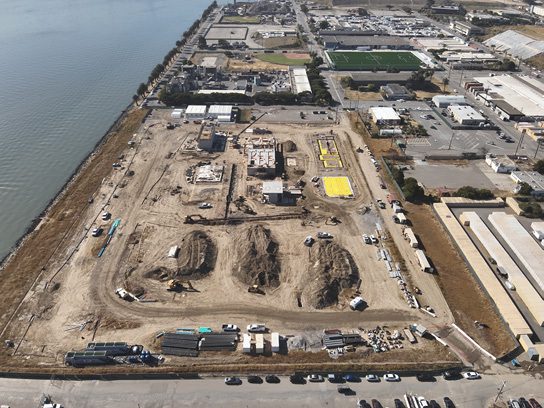
Sitting mid-way between San Francisco and Oakland, Treasure Island promises a return to glory as the Magic City in the bay. To get there, SFPUC sets the stage for success with a state-of-the-art Resource Recovery Facility that rethinks everything from nutrient removal to water recycling. (PCL/Stantec Design Build)
Jignesh Desai appreciates clean water, perhaps more than most. He is the senior project manager for the San Francisco Public Utilities Commission (SFPUC) and currently is managing more than $1 billion in capital investments in a wastewater program serving a population of 1 million in the City and County of San Francisco. He’s also a registered professional engineer in California, LEED accredited, DBIA certified and credentialed as an Envision Sustainability Professional. Ask him about his work, however, and Desai begins with his childhood.
“Growing up in India, as a child I remember waiting in line with my mother for water,” relates Desai from a field office at one of the many project sites under his purview. “We got three buckets a day from a tanker truck. My community didn’t have any running water, no sanitation, no utility power. Seeing the worst of public sanitation led me to become an engineer.”
After earning a master’s degree in chemical engineering from the Indian Institute of Technology, Mumbai, Desai earned a second master’s degree at the University of Southern California. He moved to northern California to take an engineering position at San Francisco International Airport and stayed for five years before finding his life’s calling with the SFPUC in 1999.
“SFPUC comprises three essential utilities—water, sewer and power—that operate 24/7. We employ about 2,300 people in seven counties who manage $13 billion of infrastructure within a $700 million budget,” Desai says in introducing the company he keeps. “Our mission is to provide our customers with high-quality, efficient and reliable water, power and sewer services in a manner inclusive of environmental and community interests, and that sustains the resources entrusted to our care.”
Balancing Gray and Green
Long-known as a worldwide leader in environmental stewardship, San Francisco has been thinking about the impacts of human existence on the future of humanity since before the Beats became hippies. Today, recycling is non-negotiable in San Francisco, and the city diverts 80 percent of its waste from landfills. Similar thinking was applied to San Francisco’s water resources recovery in the early 1970s when engineers decided to treat stormwater with the same care and consideration as wastewater.

Tracking 64 key indicators in five categories of sustainability and resiliency, the Envision certification framework compels holistic success across all facets of planning, design, construction and social wellbeing. The use of design-build allowed SFPUC, PCL and Stantec to assess project risks individually and assign each to the party best suited to manage it. (PCL/Stantec Design Build)
“During San Francisco’s non-rainy season (April through October), motor oil, gasoline and other environmental contaminants accumulate on our streets,” explains Desai. “When the rain hits in November, all of that would be washed from the streets into the bay or the ocean. In 1970, SFPUC constructed large transport/storage boxes and started running stormwater through treatment. Presently, our system collects rainwater from about 49 square miles. During heavy rains, SFPUC can treat some 575 million gallons of water a day through our combined facilities.”
As the guy overseeing all that and more, Desai takes pride in his employer’s forethought and hopes to add to the SFPUC’s legacy of sensible stewardship in his time. For Desai, well-conceived infrastructure ought to be a balance of what’s gray and green. Achieving such a balance means finding new ways to return water to nature while creating ecosystems of change. This is the logic behind the water resource recovery center SFPUC is building on San Francisco’s Treasure Island.
“The systems we are developing for Treasure Island will have a wetlands component, whereby onsite stormwater runoff is diverted to a wetlands area to be cleaned and absorbed as irrigation, while roof drains from buildings are diverted to vegetation. This is genuinely green infrastructure,” says Desai of what’s to come.

Using wetlands, roughly half of all water entering Treasure Island’s Resource Recovery Facility will be recycled as utility water in the years to come. The wetlands also will offer a verdant ecosystem in the bay, demonstrating the SFPUC’s interest in balancing gray and green infrastructure. (PCL/Stantec Design Build)
An Unusual Treasure
Treasure Island and Yerba Buena Island combine to be a unique part of San Fransisco that people outside the Bay Area likely don’t know much about. “Treasure Island is a man-made island out in San Francisco Bay built to host the 1939 Golden Gate International Exposition,” notes Desai.
Something of an engineering story itself, Treasure Island started with a problem. Yerba Buena Island sits at roughly the mid-point between San Francisco and Oakland across the bay. Next to it, a dense clump of dangerous rock known as Yerba Buena Island Shoals, rising from the bay 27 feet off the island’s northern tip, posed a shipping hazard.
Turning obstacle into opportunity, between 1936 and 1937, the U.S. Army Corp of Engineers (USACE) constructed Treasure Island by emplacing 260,000 tons of quarried rock in the shoals and filling them in with sand dredged from the bay to create a 400-acre island. Treasure Island’s carefully planned ground plane was built as an Art Deco Magic City of towers and gardens, gleaming goddesses, and dramatic lighting effects. Sitting in the bay and facing the city to the west, Treasure Island was built to celebrate San Francisco as an economic, political and cultural force of the Pacific. And to be a Naval station, when the party was over.

Designed for a peak capacity of 2.9 MGD, the Treasure Island Resource Recovery Facility has been carefully coordinated to start-up with approximately one-third flow in 2026. PCL/Stantec and the SFPUC’s operators worked side-by-side throughout the design-build process to ensure operator integration pays off with a smooth transition and ease of operations in ownership. (PCL/Stantec Design Build)
Fast forward almost 60 years to 1997 when the naval base closed, and Treasure Island was leased to the city. Since then, Treasure Island has slowly become home to some 2,000 residents along with a small collection of businesses, schools, arts and athletic organizations, and community groups.
“The idea behind Treasure Island was to dream big,” continues Desai. “San Francisco is at it again. The city is passionate about affordable housing and intends to increase its stock significantly on Treasure Island in the coming years. There will be an estimated $2.5 billion of new development in hotels, parks and recreation, retail, wellness, culture, and entertainment. Treasure Island and Yerba Buena Island will combine to be a new, micro-city in San Francisco Bay.”
Growing Needs Met with Design-Build Method
With the population expected to surge to 10 times today’s relatively modest figure to a full build-out projection of 20,000 residents, visitors and workforce, the SFPUC didn’t expect the small, ancient wastewater treatment plant built for the Navy decades earlier to meet future demands.
“The new Resource Recovery Facility on Treasure Island will be the first fully new wastewater treatment facility the SFPUC has built in nearly 40 years,” says Desai, who is delighted to bring a plant to life from the ground up for the first time in his 30-year career. To do so, he selected the fixed-price design-build methodology as the way to go.
Although the SFPUC hasn’t delivered many projects of their own as design-build, Desai knows a lot about it. As the chair of the Certification Committee at the Design Build Institute of America, he is well-versed in the method’s benefits and expectations. “The biggest benefit of design-build was that by bringing in the contractor from the start, SFPUC is not carrying gaps in time due to process. In this case, we went from NTP (notice to proceed) for design to NTP for construction in just eight months.”
The responsibility of marshaling the brainpower, manpower, materials and resources required to deliver SFPUC’s new Resource Recovery Facility fell to Baird Kerr, project manager for the PCL/Stantec design-build delivery team.
Like his client, Kerr has an appreciation for the impact his work makes. Although he grew up in Alberta, Canada, with access to clean water and sanitation, he also takes pride in improving the lives of others and enjoys the start-to-finish involvement of the design-build process.
“I love the process and the finished product,” says Kerr. “The nature of this work is that it’s always challenging. I like knowing that what we are building will far exceed my lifetime, making a difference in lives lived on Treasure Island for generations to come.”
He also appreciates SFPUC’s choice of design-build as the delivery method, further suggesting that the Treasure Island project is an exemplar of the model’s benefits.
“To mobilize for design in January 2023, mobilize for construction in August 2023, and now, 10 months later in June 2024, we have nine structures in the ground and topped off means we are moving at an exceptionally fast pace for a program of this magnitude,” explains Kerr.
A Strong Envision
Kerr is joined by his design-build counterpart, Stantec Project Manager Tasmin Brown, to discuss the project and the team’s incorporation of the Envision certification framework. Developed by the Institute for Sustainable Infrastructure, the Envision program encourages systemic changes in the planning, design and delivery of sustainable, resilient and equitable civil infrastructure through education, training and third-party project verification.
“SFPUC is committed to improving the sustainability of its infrastructure,” says Brown. “This will be the third Envision-certified project they have completed.”
Designed to help owners, designers, builders and stakeholders make holistically beneficial decisions, Envision tracks 64 sustainability and resiliency indicators organized across five categories: quality of life, leadership, resource allocation, natural world, and climate and resistance.
“In water/wastewater, there are always different problems,” adds Brown. “The key drivers are a combination of schedule, budget and stakeholder issues. Design-build brings all parties together to solve whatever challenges a project faces.”
As the first new construction project for the SFPUC in decades, the Treasure Island Resource Recovery Facility will take advantage of many of the latest treatment technologies, including membrane bioreactor and UV disinfection. It also will be the first SFPUC project to include full-stream nitrogen removal during the secondary treatment process. This is part of a $1.5 billion systemwide plan to substantially reduce nutrients discharged to the bay. Where the team sees the biggest deviation from “business as usual” is the amount of water recycled as utility water on the islands.
“Taking advantage of the wetlands and nutrient-removal components of this project, about half of all the water coming into the plant will be recycled as utility water on the islands, which is tremendous,” continues Brown.
Synchronizing all this to accommodate the anticipated population of these islands in 2036, while right-sizing the Treasure Island plant for the 2026 population, also is challenging.
“The design considers Treasure Island’s population growth over the coming years,” says Kerr of a technical concern that isn’t often encountered in wastewater. “This means the plant has to be designed and built to start up with reduced flows; far less than the intended capacity, which is unusual.”
According to current calculations, the Treasure Island Resource Recovery Facility will have to start up with a flow of approximately one-third of full capacity. Expectations are that by 2036, the plant will receive 1.3 million gallons a day (MGD) with a peak capacity of 2.9 MGD.


Composed in the shoals of Yerba Buena Island mid-way between Oakland and San Francisco, the USACE started building Treasure Island in 1936 to host the 1939 Golden Gate International Exposition and announce San Francisco as a capitol of commerce and ideas on the Pacific. Celebrating 90 years of dreaming big in the bay, the SFPUC’s Resource Recovery Facility arrival in 2026 will hail another series of firsts for America’s most-sustainable city. (PCL/Stantec Design Build)
Holistic Thinking
While most readers will be familiar with the design-build delivery method’s pluses—speed to market, single point of accountability, advantageous risk allocation—Brown illuminates that in a facility designed to account for the extremely complex conversion of wastewater to drinking water, the long-term benefits of early operator involvement can’t be overstated.
“SFPUC’s use of design-build allowed its facility operators to have direct input into the design and delivery process from day one,” says Brown. She shares that while PCL was scouring the design solution for constructability and cost consciousness, SFPUC’s operators were interested in functionality, ease of operations and maintenance, and ergonomic sensibility. “Of course, the operators were thrilled to be involved. When it’s time for startup and commissioning, the handoff will be seamless.”
Although the handoff might be seamless when the facility is complete, the site and situation remain challenging during construction. For Kerr, the first thing that comes to mind is the site’s unusual geography in the middle of San Francisco Bay.
“Logistically, there is one way in and one way out,” says Kerr of the complexity of building on an island. “There has also been an issue getting temporary and permanent power established because of the island’s current capacity and the traverse across the bay required of all supplemental power sources.”
As SFPUC and the PCL/Stantec team leverage design-build and the Envision framework to dream big on Treasure Island, Desai reflects on the lifetime of progress he has seen with his own eyes. He summarizes it with ease.
“There is a paradigm shift in implementing large infrastructure,” concludes Desai. “As wastewater engineers, we are used to overbuilding; making sure all the pumps and blowers and equipment were three times as big as they needed to be. Today, we see that’s not practical or wise. Design-build and Envision combine to help us think holistically about the environmental and social aspects of being a good neighbor. What I want people to take away from this is that the right project partners can form a human collective to produce something better than what we could create on our own.”

About Sean Vincent O'Keefe
Sean Vincent O'Keefe is an architecture and construction writer who crafts stories and content based on 20 years of experience and a keen interest in the people who make projects happen; email: sean@sokpr.com.