Yadkin Water for Yadkin Needs – Securing Union County’s Water Future
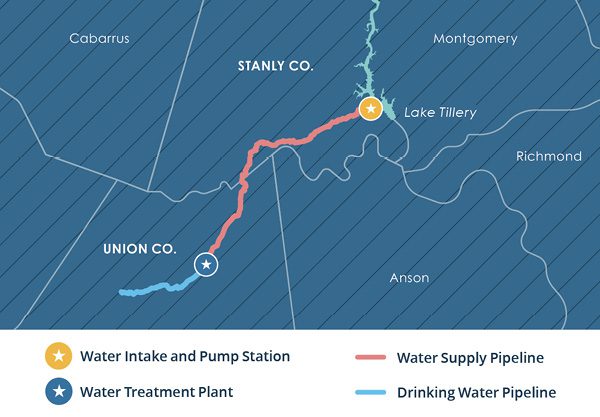
A high-level overview of the Yadkin Regional Water Supply Project through south-central North Carolina. The intake and pump station are in Norwood, the water-treatment plant is near Unionville, and the drinking-water pipeline connects to Union County’s existing distribution systems in Monroe.
More than 20 years ago, Union County, N.C., nestled just south of Charlotte, faced a looming challenge: how to secure a reliable water supply for its surging population. The existing system soon would become inadequate, but devising a solution proved complex and multifaceted.
With no natural water sources within its boundaries and straddling the Catawba and Yadkin River basins without direct access to either, Union County had to think outside of the box, forging partnerships beyond its borders to meet its water needs. Historically, approximately 85 percent of Union County’s water had been sourced from the Catawba River Water Supply Project, a collaborative effort with Lancaster County, S.C. The remaining 15 percent had been acquired through an agreement with neighboring Anson County.
Navigating these geographical constraints and ensuring a steady water supply required strategic alliances and innovative solutions, reflecting Union County’s proactive approach to resource management. The county needed a new long-term, sustainable water source and treatment capacity to meet current and future demands, as the historical approach was projected to be unsustainable.
In response to these concerns, county leaders, in collaboration with engineering firm HDR, conducted an environmental study analyzing 12 options for a new water supply. The study identified Lake Tillery as the best option to meet current and future demands. This led to the launch of the Yadkin Regional Water Supply Project (YRWSP). The ambitious project included the construction of a new, higher-capacity intake facility and pump station on Lake Tillery; an approximately 30-mile-long water-supply pipeline to a 12 million-gallon-per-day water-treatment plant in Union County; and a 10-mile-long drinking-water pipeline to connect with Union County’s existing distribution system, serving Yadkin River Basin customers.
Union County’s Water Partnership with Norwood
The Town of Norwood, situated in Stanly County, has significantly benefited from its partnership with Union County. Through the YRWSP, Norwood now receives 600,000 gallons of water per day, which is four times the amount the town previously had access to before the program. Norwood’s old water-intake facility, constructed during World War II, had not seen major updates since the 1980s. This project also provides Norwood with a new monthly revenue stream, enhancing its financial stability. Altogether, this initiative allows Norwood to withdraw a higher capacity of water, supporting its own projected future growth.

The YRWSP intake facility and pump station along Lake Tillery in Norwood, N.C.
Being a Good Neighbor
Being a valued neighbor necessitates a deep understanding of the surrounding community. Recognizing this, the project team remained steadfast in its commitment to seamlessly integrate the pump station into its surrounding neighborhood.
Situated in the picturesque Norwood neighborhood overlooking Lake Tillery, many property owners cherish these residences as tranquil retreats or vacation homes. Traditionally, water-supply infrastructure installations such as intake facilities and pump stations have an industrial look that risks disrupting the serene ambiance of their surroundings. To counteract this potential discord, Union County pursued an innovative approach, employing an architectural design for the facility that mimics the appearance of a lake house to seamlessly fit in with its neighbors.
Similarly, for the water-treatment plant, located in a rural area of Union County, the team aimed to mirror the essence of the surrounding agricultural community. Opting for an architectural design that complemented the agricultural surroundings, the county selected the shape of a barn for the administration building, allowing it to blend in effortlessly.
Structured Approach to Project Management
Union County sought a trusted advisor to serve as program manager and provide guidance in taking on one of the largest water infrastructures in North Carolina’s history. County leadership selected HDR as the program manager to guide the initiative. The YRWSP was divided into two main projects: the Raw Water Infrastructure (RWI) Project, which covered the intake and water-supply pipeline, and the Finished Water Infrastructure (FWI) Project, which included the water-treatment plant and drinking-water pipeline. These infrastructure projects were overseen by a set of design-build (DB) firms: Garney Construction and Hazen & Sawyer managed the RWI project, while CDM Smith oversaw the FWI project. Both sets of firms reported directly to HDR.
This vigilant approach helped ensure there was alignment across all facets of the program as the project progressed. By fostering transparency and proactive communication, Union County, HDR and the DB entities upheld a commitment to the RWI project to deliver raw water to the FWI project and brought the YRWSP to substantial completion on Feb. 19, 2024.
Multifaceted Construction Challenges
To build the YRWSP, a wide range of construction activities were required for all aspects of the project. Activities included underwater work at Lake Tillery, where scuba divers worked at the intake to guide a microtunnel machine, weld the pipeline and structural steel, and confirm foundation requirements. Deep excavation work was required for both the wet well at the pump station and at the water-treatment plant.
Pipeline installations included open cut, blasting, road and rail crossings, crossings of high-pressure gas mains, major river crossings, building steel erections, crane operation within a neighborhood, and more. Crews had to work across more than 300 separate private properties stretching across 40 miles along the pipeline route, some in remote and rural areas and others in suburban and “main street” settings. This required adaptable, detailed construction approaches and safety practices.
A distinctive aspect of the YRWSP involved the project team working from a barge to construct the new water-intake facility on Lake Tillery. The barge was launched upstream and positioned near the pump-station site, allowing construction materials to be staged nearby. With its large crane, the barge minimized disturbance to the shoreline and surrounding lake ecosystem during material transport.
Lake Tillery, a popular recreational spot for the boating community, necessitated several safety measures for recreational users. These included alerts posted at two public loading areas to inform boaters of waterway activities, solar-powered LED marine safety lights on the barricade buoys, and a debris-shield curtain.
Bridging Gaps through Public Engagement
The project engaged a broad spectrum of stakeholders with diverse concerns and interests. Spanning across Norwood, suburban areas, farmland, commercial establishments, private parkland and mining properties, the water-supply pipeline traversed varied terrains, municipal boundaries and a county line. This necessitated an evolving public-relations strategy aligned with project milestones (e.g., permitting, early design, pipeline routing, easement acquisition and construction) focused on setting expectations on how the public would be impacted. Stakeholder outreach targeted directly impacted property owners, Union County Water customers, internal team members, decision-makers, prospective employees for new facilities, and surrounding counties and activist groups.

A floating barge was used as the primary construction staging site for the YRWSP’s new intake facility and pump station at Lake Tillery.

A photo shows the YRWSP water treatment plant located in Monroe, N.C
To facilitate communication, the YRWSP team utilized multiple outreach channels, including a prominently advertised project hotline, a dedicated email account, regular social-media updates via Union County profiles, a project-specific website, e-newsletters, bill inserts, public meetings, educational videos and more than 85 rounds of mailings to residents along the project’s 40-mile route. In-person and virtual property-owner meetings also were held to keep impacted property owners engaged and educated about the project and their parts in it.
Environmental Stewardship
Lake Tillery not only serves as a water source but also helps power the region through the Duke Energy-operated Tillery Hydroelectric Plant. This makes the lake subject to Federal Energy Regulatory Commission (FERC) oversight, ensuring strict environmental stewardship. FERC approval was required for any lake modifications, fostering collaborative efforts that benefited both the lake and community. For instance, during the construction of the new intake facility, innovative methods such as microtunneling were used to minimize environmental impacts, with scuba divers retrieving equipment after the intake pipeline was complete to further reduce disturbance to the lake. Construction staging for lake work and the use of a floating barge also prioritized environmental protection.
Despite drawing water from the lake, studies indicate the project has minimal impact on the lake’s water levels. Minor changes—less than half an inch—could occur 1 to 2 percent of the time (equivalent to three to seven days annually). Even during severe drought conditions, the lowest-modeled water level still would be 2 feet above the lake’s public boat ramps, ensuring recreational users would not notice any significant impact.
A Strategic Approach to Water Security
Union County’s efforts to secure a reliable water supply stand as a testament to strategic foresight and collaborative innovation. More than 20 years ago, faced with daunting challenges and geographic constraints, Union County forged partnerships and embraced innovative solutions to meet growing water demands sustainably. The YRWSP, anchored by Lake Tillery and driven by meticulous planning and community engagement, exemplifies a proactive approach to resource management. From navigating regulatory hurdles to implementing environmentally sensitive construction practices, the YRWSP not only safeguards water access but also enriches communities such as Norwood and Stanly County with new economic opportunities. As Union County celebrates the successful completion of the YRWSP, it underscores a commitment to resilience, environmental stewardship and community-centric development for generations to come.

About John Shutak
John Shutak is the Engineering Division director for Union County, N.C.; email: john.shutak@unioncountync.gov.