Progressive Design-Build Delivers a High-Risk, High-Reward Bioenergy Facility
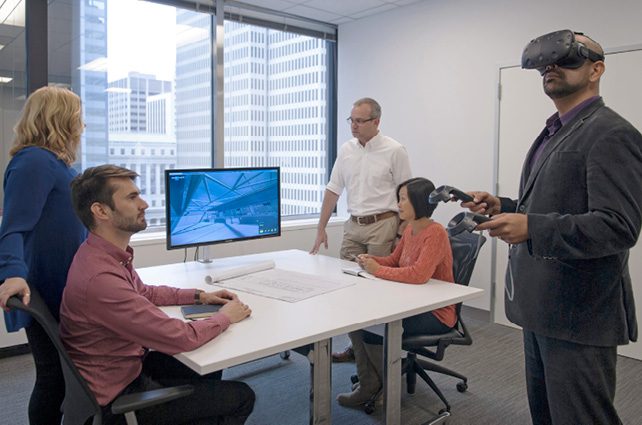
Stantec used Oculus 3D augmented-reality headsets to convey design and operation details to owners and facility managers.
The $271 million Piscataway Bioenergy Facility in Prince George’s County, Md., (part of the Washington, D.C., metro area) is one of the most technically sophisticated sewage facilities ever completed in the United States. It’s only the seventh facility in the United States to implement thermal hydrolysis, a two-stage process that treats sludge with high-pressure boiling and then releases pressure rapidly to break down microorganism cell walls and kill pathogens, creating Class A biosolids that are safe for land use (fertilizer).
The facility also uses an advanced combined heat and power (CHP) system and anaerobic digestion combined with wash water treatment technology to produce and treat biogases (including methane). The gases are converted into renewable natural gas, which is partly used to heat and power the facility and partly sold on to power Montgomery County’s Ride On bus fleet (bit.ly/3CD7bus). The fertilizer and biogas are a revenue stream for WSSC Water, projected to deliver $4 million in annual revenue, as well as a cost cutter that will save WSSC Water customers $3.4 million annually in operating costs. As it scales up, Piscataway will collect and process biosolids from all five of WSSC Water’s treatment facilities and potentially accept trucked-in biosolids from other regional sites.
A large, progressive, technically accomplished project such as the Piscataway Bioenergy Facility requires an established project-delivery system. “Stantec provided lead engineering and design, PC Construction was the design-builder, and Hazen and Sawyer was a major subconsultant to us,” says Stantec Senior Vice President Joe Uglevich. “Plus, about a dozen other subconsultants provided specialized engineering on the project. We used the ‘best athlete’ approach to assign staff and deliver the work internally. This resulted in a globally distributed team of hundreds of engineers and architects. That could have been difficult, but we were successful with the progressive design-build delivery model—the first time it’s been used on a big wastewater project with WSSC Water. In the end, the project team ended up thinking that no other project delivery system would have been nearly as effective.”
Progressive design-build (PDB) is a project-delivery method that combines the benefits of design-build with early contractor involvement. “Progressive design-build brings designers and builders together to collaborate much earlier and allows different perspectives to be incorporated before decisions get entrenched,” says PC Construction Project Director Robert Wierzbicki. “We had subject-matter experts from every specialty weighing in early, making for much more accurate pricing and a more constructable design.”
Progressive design-build is a relatively new delivery model in the region and is now being implemented on more large and high-risk construction projects. “This was the largest and most-advanced project in WSSC Water’s history, and the first time they went with progressive design-build collaborative delivery,” notes Uglevich. “We were able to provide a guaranteed maximum price at the 60-percent design level.”
Stantec believes the merits of PDB project delivery are likely to make it a more-routine collaboration method in the design and construction of large, complex infrastructure facilities, especially those with a high-risk profile. In a thought-leadership article (bit.ly/3Qebqzz), Stantec designers Tasmin Brown and Patrick Stahl wrote of the Piscataway facility specifically:
“There was a high degree of perceived risk in the technology for the project, and using progressive design-build allowed the client to benefit from control of the design. It also helped operators to learn about the facility’s function while it was being designed. Ultimately, it allowed us and our contractor partner to handle three big risks: manufacturer supply chain issues, delivery schedule, and management of overlapping vendors directly.”

A cutting-edge thermal-hydrolysis process facility was completed at Piscataway.
Creating a Federated Model
Of course, Stantec is used to mitigating the design and construction risks of advanced projects that require the coordination of distributed teams of specialists using their “best athlete” approach. “It’s our way to say that we have a central delivery model at Stantec, and we look across North America and the globe to find the right people for complex projects like this—we need to be sure that people leading these disciplines have done this before and have the right experience,” explains Uglevich.
“The platform for our civil design work was Autodesk’s Civil 3D,” says Stantec Process-Mechanical Discipline Co-Chief David Socha, P.E., PMP. “Individual models were developed for each of the different disciplines, like process mechanical, building, mechanical, structural, architectural, electrical, etc. And then we bring all those individual models into what we label a federated model where you can see how everything gets combined.”

A photo shows the Piscataway combined heat and power (CHP) and gas-handling systems.

A photo shows the Piscataway Bioenergy Facility digesters.
Access to the model is controlled by Autodesk Construction Cloud, “which evolved out of BIM 360 and has the exact same approach but has the added benefit of allowing us to identify issues in the tool itself,” explains Socha. “Anybody from the project has access to the model, and anyone we’re working with can get into the model and identify any issues or observations that they have, and those are added into the big model and tracked until every individual element is resolved.”
PC Construction was able to use the model, updated with interim as-built scanning, to identify and avoid clashes during construction. “The software was able to stitch together our Trimble data with the federated model, and then we could import models from vendors and check for clearance,” explains Wierzbicki. “I remember one issue with conveyors: the gearbox on the conveyor motor was hitting the handrail, and we were able to identify that issue before the components were even shipped. That is another advantage of progressive design-build: we pre-selected and pre-negotiated with four or five vendors for some major pieces of equipment. They provided design-assist drawings, which were a big help when installing major pieces of equipment and was one way we avoided construction delays.”
Biosolids, Biogas, Bioenergy
Humans have been producing energy from human waste for a long time. In the 10th century BC, Assyrians used biogas to heat bathwater, and, by 1895, biogas recovered from a sewage treatment plant in Exeter, England, was being used to fuel streetlamps. But it’s fair to say that bioenergy facilities such as the one at Piscataway are a fast-moving sector of infrastructure innovation, and bioenergy technologies still are evolving.
“There are two key technologies being used here: one being the thermal hydrolysis process and the other being what we call the gas-upgrading unit, which upgrades the quality of the biogas produced in the anaerobic digesters that treat biosolids,” explains Socha. “Biogas is a mixture of 60 percent methane, 35 percent carbon dioxide and about 5 percent other gases like water, nitrogen, etc., which gets purified to match the quality of commercial natural gas.
“There’s another key technology called pressure-swing adsorption,” he adds. “We determined that in this case water-wash technology was appropriate—that technology uses water at low temperatures to remove the contaminants from biogas to transform it into almost pure methane with characteristics that are identical to the natural gas that runs through the pipelines and feeds our houses and vehicles.”
One unexpected challenge came when delivering gas to Washington Gas, where a “mini gate station” performs several important procedures, including pressure regulation, filtration, odorization (when odor is added), metering and monitoring. “The mini gate became a constraint on design, as we had to provide the quality of gas the utility was expecting,” notes Uglevich. “We had many conversations with the utility about how to do that, and our design evolved as a result. It is critical to understand the gas and monitoring requirements since the utility can shut off the connection if the gas is off-spec, and then the gas must be used internally or burned off with a flare.”

The Piscataway Bioenergy Facility includes side-stream reactors.
Stantec has developed a specific model for bioenergy projects that relies on past experience in the UK to help establish design parameters since a similar tool does not exist in the market today. “The combinations of technologies on this project, especially the thermal hydrolysis process, gas-upgrading and CHP, are relatively complicated,” says Uglevich. “We’ve done similar projects before; Stantec has been involved in 15 to 20 such facilities in the UK, and we really leaned on that experience to develop proprietary spreadsheet applications to model mass and energy balance—that helped us resolve size and capacity questions for the project. Also, Hazen was a major subconsultant on this project, and their experience and expertise was invaluable.”
This, combined with PC Construction’s experience delivering highly complex treatment facilities and the first-ever THP project in the United States, was leveraged to successfully deliver the Piscataway Bioenergy Facility.
Construction and Handoff
Delivering a facility that separates, pressurizes, stores and circulates potentially explosive gases requires extraordinary detail in design and construction as well as care in the handoff to owners. There are high pressures and system transitions to consider, and obviously the gas itself is potentially explosive, explains Uglevich. “And then, the sheer volume of the gas is a consideration at this facility, where we’re guided by National Fire Protection Agency and ANSI codes, and additional safety measures are derived from industry standards. Designing the gas system is a challenge—the engineering is interdisciplinary and specialized.
“The short answer is that everything in close proximity to gas, like instruments, has to be explosion-proof, and significant monitoring systems are required,” he notes. “We follow a very careful process to design the system safely.”
The handoff procedures also must be rigorous; after all, there aren’t many advanced bioenergy facilities in the country, so there aren’t many experienced operators. One way Stantec helped operators learn about the facility’s function while it was being designed was via use of Oculus augmented-reality headsets.
“We ended up with a very large drawing set,” Uglevich points out. “And it’s tough for the facility managers and operators to go through all material and have any confidence they were learning how to run Piscataway safely and efficiently. We sensed they were struggling, so we brought in the 3D glasses to put them right in the model.”
These augmented-reality “classes” were sometimes held at the facility site. “They could actually ‘walk through’ various parts of the plant and answer detailed questions for themselves like, ‘Can I reach that valve?’ ‘Can I touch that pump?’ or ‘Does this room look the way I expected?’ It worked well.”
Win Win (and Win)
“Two streams of benefits flow from Piscataway Bioenergy Facility,” explains Socha. “The first is that, before this project, all these biosolids were hauled to landfills, which is rather costly. The implementation of thermal hydrolysis lets WSCC convert 40 to 50 percent of those solids into biogas—that’s a big savings over hauling, and the gas is revenue. And second, the value of the remaining biosolids is increased by meeting stringent quality standards. They become fertilizer that could be sold on, so that’s another potential revenue source.”
These revenue streams come with plenty of options. Fertilizer can be pelletized, for example, or otherwise processed for particular use cases, and gas can be refined as needed for varied uses such as bus fleet fuel, internal facility use for power or heating, or for direct sale to utilities.
“And there’s a third benefit stream, if you want to look at it that way,” adds Socha. “Biosolids are a renewable resource, of course, so this is a cleaner, greener option, and credits are commercialized in today’s market—so that’s yet another benefit and potential revenue source.”
Human waste is sometimes termed “black gold” by the wastewater sector, and the project team’s successful completion of the Piscataway Bioenergy Facility suggests the world is entering a new “Golden Age of Sewage Infrastructure.”

About Angus Stocking
Angus Stocking is a former licensed land surveyor who has been writing about infrastructure since 2002 and is the producer and host of “Everything is Somewhere,” a podcast covering geospatial topics. Articles have appeared in most major industry trade journals, including CE News, The American Surveyor, Public Works, Roads & Bridges, US Water News, and several dozen more.