Ocean Pavilion at Seattle Aquarium Showcases Design and Human Experience
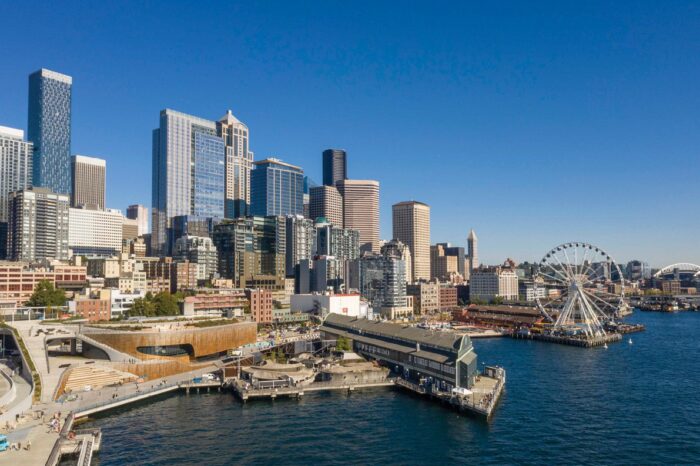
Following removal of the Alaska Way Viaduct, Seattle’s Waterfront has been reimagined as a vibrant promenade stretching across the city. At the water’s edge, the Seattle Aquarium’s new Ocean Pavilion offers a glimpse of aquatic life at the far reaches of the Pacific Ocean while adding an architectural gem to the harborside cityscape. (Lara Swimmer/Est)
Emerging from the unification of place, purpose and point of view, the best of the built environment amazes in many ways. Considering the time, talent and tenacious learning required through centuries to design and build the world’s infrastructure and the architecture we inhabit, it’s not a stretch to say what we build reflects who we are. In the heart of Seattle, right at the water’s edge, one example is the newly opened Ocean Pavilion at the Seattle Aquarium. Designed by LMN Architects and delivered by Turner Construction, Ocean Pavilion added an elegant architectural gem to the revitalization of the Seattle Waterfront while illustrating the intricacies of transforming vision into reality.
“What I love about my work is pushing the boundaries of what is possible,” begins Scott Crawford, a Partner at LMN Architects. Crawford joined LMN in 2009 and has since played a key role in several high-profile, technology-focused commissions such as Octave 9: Raisbeck Music Center designed for the Seattle Symphony as well as the Ocean Pavilion project. He also is a founding member of LMN’s Tech Studio, which uses computational design tools to explore limitless iterations in pursuit of transcendent architectural solutions. “Asking lots of questions combined with computational analysis lays a foundation for developing something exceptional.”
Reimagining the Waterfront
Arising out of the regeneration of Seattle’s historically separated waterfront, the story of the Ocean Pavilion begins with the removal of the Alaskan Way Viaduct. In 2019, the Washington Department of Transportation demolished the hulking double-deck highway that ran 2.2 miles north-south across the face of Seattle. Doing so opened the door for a rethink of the city’s central spine, the Seattle Waterfront.
“On the outside, Ocean Pavilion is a new 50,000-sqaure-foot building that adds to the Seattle Aquarium’s existing harborside campus,” continues Crawford. “The complex also connects historic Pikes Place Market across the street to the Seattle Waterfront. Whereas the existing aquarium is a habitat for native species local to the Pacific Northwest, Ocean Pavilion explores aquatic life on the opposite edge of the Pacific Rim. This is a reef ecosystem based on the Coral Triangle—a region in the Indo-Pacific so rich in biodiversity that it’s considered the Amazon of the ocean. Architecturally, the juxtaposition of these interconnected borders directed our response. This building is one piece of a giant puzzle connecting the city to the water and Seattle to the other side of the Pacific.”
Programmatically, Ocean Pavilion’s design began with two central requirements: a massive aquatic habitat and a human-centered experience surrounding it. With marine life as end-users, accessible immersion as a programmatic objective, and profound respect for the natural and indigenous worlds as aesthetic motivation, the LMN team embarked on an exploration of the limits of pragmatic possibility.
“The starting point is the 500,000-gallon aquarium and the life-sustaining requirements of the ecosystem’s occupants, which are many,” says Crawford. “Surrounding that, we wanted to eliminate what is often a linear sequence of exhibits. Instead, we created a set of interconnected loops. Circulation passages surround and perforate the aquarium, allowing visitors to move up, down and across, compelling them to experience things from many perspectives.”


Ocean Pavilion’s non-linear sequences and non-orthogonal building forms combine to produce an immersive experience for building users on both sides of the glass. Custom-cut formwork rendered from expanded polystyrene foam blocks was filled with 680 yards of concrete in 21 hours to create the aquarium’s curved structural walls. (Lara Swimmer/Esto)

Integrating Indigenous insight into the project included designing a large circular gathering space known as One Ocean Hall. A bevy of integrated audiovisual technologies combines with a maker-made community-seating platform to account for a submerged marine-life experience in several unique Pacific environments. (Lara Swimmer/Esto)
Expert Collaboration
LMN takes pride in innovation. Bringing new solutions to the table on a project of this complexity requires collaborating with an array of experts. In the case of Ocean Pavilion, those included everyone from the rebar fabricator to the aquarium’s marine biologists.
“Inside the reef habitat, rather than swimming primarily in one direction, sharks need to exercise both sides of their bodies,” explains Crawford. “The habitat’s figure-eight configuration helps encourage the sharks toward the center, keeping them balanced.”
Beyond the complexity of occupant needs—feeding and filtration—structurally retaining 500,000 gallons of water within the concrete walls was no small order. Incorporating 355 tons of rebar and 680 cubic yards of concrete, Ocean Pavilion’s curved concrete walls are several times thicker than a typical concrete building.
“The reef requires a water depth of 28 to 30 feet,” notes Crawford. “Due to the hydrostatic pressure of the water against the tank walls, the concrete had to be about 2 feet thick. At that point, we started asking what else the walls could do. Could we put a park on the roof? Could we eliminate columns inside? Ultimately, we hung most of the structure from the roof because the walls were so stout.”
The result is a dynamic building form. On the outside, Ocean Pavilion resembles the hull of a massive ship cutting through the waves. On the inside, the structure is organic, flowing and formless.


LMN Architecture worked with local artist Dan Friday to develop Ocean Pavilion’s one-of-a-kind ceiling treatment. Based on a Salish Spindle Whorl, a tool used to weave precious Indigenous textiles, the soffit is composed of 235 panels cut from Richlite on a CNC machine at The Shop. This is a full-custom, self-produced and assisted-assembly product design and delivery. (Lara Swimmer/Esto)
Detailed Design
As any seasoned designer knows, pushing the boundaries of possibility in design is only worthwhile if it can be realized on schedule and budget during construction. While unlimited imagination during design seems an asset, buildability is where the rubber meets the road. Designing the concrete core so it could be cast in place began with imagining how the required formwork could be efficiently and economically assembled.
“Essentially, there are few straight edges in the concrete forms,” adds Crawford. “The shapes are non-linear and non-orthogonal. This meant getting very creative with the contractor, Turner Construction, to think through how to build it.”
After considering the cost and time required onsite to build the needed formwork out of stacked tiles of dimensional lumber, LMN suggested expanded polystyrene foam (EPS), which is what most people think of as Styrofoam, as an alternative.
“Designing the building’s unique geometry happened in a 3D parametric model,” he notes. “We used visual scripting models and computational analytics to consider countless iterations of every space. Starting from the 3D model, the fabricator programmed a 5 Axis CNC router to cut large blocks of EPS into precisely shaped panels that fit together like a puzzle. The goal was to maximize the size of parts and therefore reduce the total number of parts that needed to be installed.”
Since design and fabrication were digitally driven, LMN transferred their 3D design models to the contractor and panel fabricator, who cut the panels in a computer-driven process.
“While we always work in 3D, the majority of that gets translated into 2D for the construction process,” says Crawford. “Here, the actual 3D model was the construction documentation. Turner also modeled every piece of rebar and every splice and tie. Being an aquarium, there was a lot of fine-tuning around MEP piping, which meant a lot of clash detection. The piping was so dense that Turner did point-cloud scans to validate and readjust the models as they built the formwork to ensure things stayed on track.”
Turner and the fabrication team at Janicki Industries created 229 panels shaped by the CNC router, which were foam-glued to a specialized backing and assembled onsite. The concrete-facing sides were sprayed with a truck-bed lining material to create a uniform surface. With the objective of no joints in the concrete, Turner built the complete formwork shell and then poured the entire 680 yards of concrete in 21 hours.
“It’s also important to talk about One Ocean Hall,” adds Crawford in returning to the building’s intent to foster a connection to both the Pacific’s inhabitants and the people who populate its shores. “The configuration of the building’s large central gathering space takes on a circular form. This form was inspired by early conversations we had with Indigenous cultural groups who shared the significance of circular gathering spaces to bring people together.”
Decked out with 12 integrated digital projectors, One Ocean Hall creates a 360-degree immersive experience featuring video and audio of the underwater experience. Staff-guided conversations allow visitors to explore a coral reef in the Indo-Pacific, a kelp forest in the Puget Sound or swim with whales in the Salish Sea as they learn about each environment.

The best architecture reflects the times, the participants and their willingness to push the boundaries of possibility. At the Seattle Aquarium’s Ocean Pavilion, LMN Architects harnessed the power of computational design to unbridle imagination without compromising cost or buildability. (Lara Swimmer/Esto)
If You Build It
For the LMN team, there’s an urge for design to be more than simply dreaming it up. Crawford and his partners also want a hand in building it. So, they created The Shop, a studio maker now in its third iteration that began with a CNC machine in Crawford’s garage.
“We like to get our hands dirty,” notes Bryant Callahan, a computational designer in LMN’s Tech Studio. “Making is essential to the way we work. It informs our design process, enhances our relationship with the contractors and their subs, and increases our understanding of renewable resources and their lifecycles in ways that holistically benefit our projects.”
Although he got a late start on architecture, like Crawford, Callahan is a craftsman. After four years of service as a U.S. Marine and eight as a graphic designer, Callahan decided to loop all he’d learned about digital design into creating physical spaces. Between 2019 and 2023, he earned a dual master’s in architecture and design technology from the University of Washington. While taking a design class taught by Crawford, Callahan found his calling.
“I was interested in computational design and how to leverage what computers can do to improve design processes,” explains Callahan. “The class gave me a preview into how LMN Tech Studio works. I was certain I wanted to be a part of it.”
Although faster iterations, early testing, design efficiency and the ability to produce the hyper-complex geometry required to make shaped space look amorphous are all tremendous benefits of computational design, being able to conceive of architecture and contribute to creating is distinct.
“LMN has a dedicated fabrication facility, The Shop, across from our main office,” says Callahan. “The Shop is a space dedicated to designing, developing, testing and delivering innovations of our conception and creation. Being a storefront location on street level, it provides an essential link to the community. My role is half in the design studio, using computational programs to design things, and half in a maker role in The Shop, exploring how to create them.”
Throughout 20th-century modernist design, many architects designed furniture to adorn schools, libraries and theaters, but there isn’t a significant history of architects making building components themselves.
“Constructability is a key consideration of any design innovation,” notes Callahan. “We use The Shop to create prototypes and mock-ups of the imaginative design elements we create with computers. This allows the design to evolve in response to buildability concerns with a very light touch. So that intent remains unblemished while we manipulate the solution. It also reduces the potential for miscommunication or misunderstanding with contractors and subcontractors about the design and how to build it.”
Communal Space
Callahan and Crawford suggest that in some way or another—such as the EPS panels developed for the formwork—almost every architectural innovation LMN employed on Ocean Pavillion spent some time in The Shop. Two pieces, however, were conceived, developed, tested, refined and fabricated wholly inhouse.
“One Ocean Hall is a communal meeting space meant to accommodate people of many ages and abilities,” continues Callahan. “We understood early on that we’d be designing and fabricating custom seating. However, during design, we also discovered the opportunity for fabricating the 6,000-square-foot soffit undulating overhead across the hall and outside above the entrance.”
The soffit is composed of custom panels made from a versatile and sustainable building material known as Richlite. Made by compressing layers of paper stacked in alternate directions to produce a solid sheet material, Richlite is durable and machinable.
“This became a complex system of things not usually found in a soffit,” shares Callahan. “First, we worked with Dan Friday, the artist who created the school of blown-glass fish that swims over the entrance to design a pattern for the ceiling based on an indigenous spindle whorl. Then, we worked with the engineers to figure out how to hang these custom panels.”
The Shop crew spent a month cutting each of the soffit’s 235 panels on their CNC machine, which the subcontractor picked up from The Shop every other day and delivered to the site for installation.
“This wouldn’t have happened with a traditional process, where we handed the design off to a subcontractor,” he adds. “There would have been far too many unknowns for cost-effective pricing. The soffit is a great example of how we can make things that are fully custom but still economical to build as designed.”
Crawford, Callahan and the LMN team believe architecture ought to be a shared experience. To spread inspiration, LMN strives to make The Shop a neighborhood asset.
“Our office is in Pioneer Square, which hosts the oldest art walk in the country,” notes Crawford. “Every first Thursday, we open our doors. We get to host a local artist or maker who gets a platform to share their process and work, while the public is welcome to learn a little about what we do and how we do it. While we were fabricating the bench for One Ocean Hall, people came back month after month to watch our progress. At LMN, architecture is about the shared human experience of entering an exciting space for the first time.”

About Sean Vincent O'Keefe
Sean Vincent O'Keefe is an architecture and construction writer who crafts stories and content based on 20 years of experience and a keen interest in the people who make projects happen; email: sean@sokpr.com.