We Don’t Have a Wildfire Problem. We Have a Building Problem.
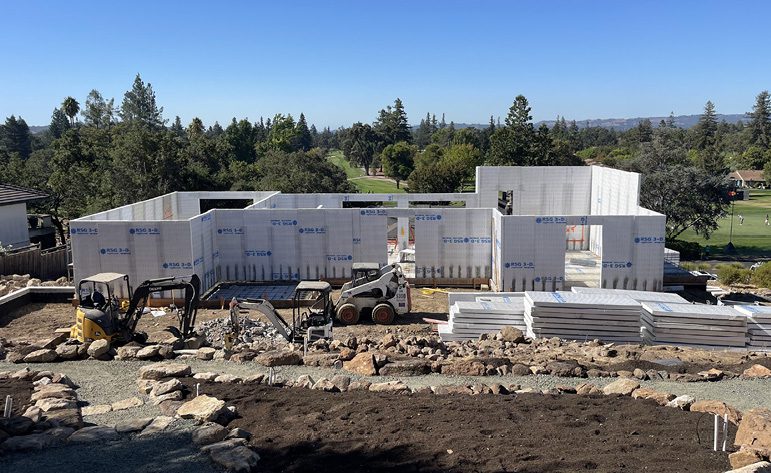
Photos show a home in Napa under construction (above) and a completed fire-resistant home (below), both built with RSG’s resilient panel building system.

Smarter materials and fire-conscious design offer a path to long-term resilience
When the Tubbs Fire tore through Northern California in 2017, it left behind a grim picture: more than 5,600 structures gone, entire neighborhoods in Santa Rosa reduced to rubble. And yet, amid the scorched earth, a small handful of homes still stood—almost miraculously intact. Their secret? Not location, not luck, but the way they were built.
This contrast of total destruction alongside unscathed homes underscores a hard truth: the problem isn’t wildfires. It’s how we build.
The Real Threat: Not Fire, but Fuel
Wildfires are a natural phenomenon, as ancient and essential as rain. They clear underbrush, cycle nutrients and even help some plant species reproduce. But the destruction they cause to human habitats has less to do with nature and more to do with the vulnerability of our built environment.
One of the most overlooked yet devastating threats during a wildfire isn’t the flame front itself—it’s the embers. Also known as firebrands, these tiny, wind-driven particles can travel miles ahead of a fire line and are responsible for most home ignitions. According to research by the U.S. Forest Service, embers often are generated when vegetation or structures burn, creating lightweight fragments of burning material that are lofted into the air. Once airborne, they infiltrate homes through vulnerable points—vents, eaves, soffits and even gaps in siding or roofing materials. Studies by the National Institute of Standards and Technology and the Insurance Institute for Business & Home Safety have shown that embers also can slip between deck boards or settle into nooks where combustible debris such as pine needles has accumulated, sparking fires in places that are difficult to detect and extinguish.
These hidden pathways of ignition highlight a larger, more uncomfortable reality: most American homes are highly combustible. Wood framing, untreated siding, vented soffits and open eaves offer a buffet of ignition points for embers. Unlike hurricanes or earthquakes—where building codes have evolved to require stronger, safer design—wildfires still are approached as a firefighting issue rather than an engineering challenge.
This makes ember resistance not just a good idea, but a fundamental engineering requirement. Designing ember-resistant vents, sealing gaps and creating tight building envelopes are key tactics. So is the use of non-combustible siding, roofing and decking materials—not just for aesthetics or durability, but as literal fire shields. Creating a 5-foot zone of noncombustible material around the perimeter of the home—free of plants, mulch or wooden fencing—also can prevent embers from collecting and igniting near the foundation.
“True resilience is about more than surviving a single event,” says Ken Calligar, CEO of RSG 3-D. “It requires a long-term perspective—one that looks beyond the next building cycle and asks how a structure will perform over decades. In an era defined by intensifying climate threats, building for the long haul is no longer optional. It’s essential.”
Lessons from the Ashes: Fire-Tested Innovation
In California specifically, after the Tubbs Fire, a range of innovative construction systems were put to the test during rebuilding. Among the most successful was a panelized building system developed by RSG 3-D. These resilient structural panel systems sandwich a core of expanded polystyrene (EPS) insulation between welded wire steel mesh, structurally connected by a proprietary truss system. The panels are coated in concrete. This composite material—lightweight but incredibly strong—is not only fire-resistant, but also thermally efficient, mold-proof and durable enough to handle extreme seismic loads.

A fire-hardened modernist home in LA’s Santa Monica Mountains designed by Zoltan Pali, FAIA. Originally a traditional 1980s stucco home, the residence was transformed into a sleek, modernist structure built to endure.
In Napa and Sonoma Counties, homeowners who rebuilt with RSG 3-D panels have seen firsthand the difference that advanced building materials can make. In several instances, while many neighboring structures were lost, these homes remained intact.
But the performance isn’t just anecdotal. These panel systems have passed rigorous U.S. and international testing, resulting in an International Code Council Evaluation and Certification. Such performance is becoming less of a novelty and more of a necessity.
“Resilience isn’t just about surviving the next fire,” adds Calligar. “It’s about ensuring a home or building can stand strong for decades to come. We need to think in terms of generational safety, not just short-term fixes.”
That long-term mindset is critical as climate change accelerates the intensity and frequency of wildfires. The old model—rebuild, burn, repeat—is no longer tenable. Shifting away from reaction and toward prevention means treating fire not as a fluke event but as a constant design parameter, just like earthquakes, hurricanes or floods. And that shift begins with the data-backed testing, rigorous standards and proven systems that have already shown they can weather the worst.
Steel as a Solution: Cold-Formed and Fire-Hardened
Mary O’Brien, co-founder of Hapi Homes, has seen the limits of traditional homebuilding materials up close. Her company focuses on pre-engineered housing with one primary material: cold-formed steel, a proven approach in commercial construction that Hapi Homes has adapted for residential use.
“Every year we watch wildfires wipe out homes that are rebuilt with the same flammable materials,” says O’Brien. “Cold-formed steel offers a much better path forward. It is noncombustible, rot-resistant, doesn’t attract termites, and it maintains its strength over time.”
In fire-prone zones such as Los Angeles, O’Brien sees steel not as an upgrade but a necessity. “We’re not talking about a niche or high-end material; steel is U.S.-made, accessible and affordable,” she notes. “The challenge isn’t the material, it’s industry adoption.”

Mid-construction on the steel frame in a Hapi Homes project in Salt Lake City.
Indeed, many in the industry still default to wood framing out of inertia, not because it’s the best material for the job. It’s familiar and deeply embedded in the building codes and culture. But with climate risks rising, contractors, engineers and designers can’t afford to prioritize familiarity over function.
Material selection, however, is just one part of the fire-resilience equation. How that material is detailed and protected can be equally critical to structural performance. One example is intumescent coatings—specialized fireproofing products applied to steel that expand when exposed to heat, forming a thick, insulating char layer. This added barrier slows down the rise in temperature in steel, delaying the loss of structural integrity and providing valuable extra minutes during a fire.
Designing for Fire: Architecture That Shields, Not Fuels
Beyond materials, architecture plays a critical role in a home’s fire resilience. Los Angeles-based architect Zoltan Pali, FAIA, founder of SPF:a, has been designing with fire in mind long before it became a mainstream concern. One of Pali’s most notable projects as an executive architect was the renovation of the Getty Villa in Pacific Palisades, which recently withstood a brush with the Palisades Fire without damage—thanks in large part to design choices and material discipline.
“We didn’t build the Getty Villa to be a fortress, but we did approach it with a deep respect for its context—both historical and environmental,” says Pali. “That meant selecting durable materials, limiting vulnerabilities and ensuring the architecture could coexist with its surroundings without compromising safety or authenticity.”
Pali emphasizes that fire-resistant design doesn’t have to be at odds with aesthetics. “You can have beauty and performance,” he adds. “Concrete, stucco, metal—all of these materials can be used elegantly. The key is integrating fire-conscious thinking from the very first sketch, not as an afterthought.”
Such early integration also is where engineers come in. When structural and fire-protection strategies are developed in tandem with architectural design, the result is a building that isn’t just beautiful or code-compliant—it’s holistically resilient. Fire resistance isn’t achieved through any one material or feature, but through thoughtful detailing at every level.
Detailing also includes designing for fire compartmentalization. Properly installed firestopping systems at joints, penetrations and wall-to-floor intersections prevent fire and smoke from traveling unchecked through a structure. This isn’t about just resisting ignition; it’s about maintaining structural stability and containment throughout the duration of a fire event.
Obstacles to Change: Cost, Code and Culture
If the case for fire-resistant construction is so strong, why isn’t everyone building this way?
The answer lies in a mix of perceived cost, regulatory inertia and cultural habit. Alternative materials such as structural panels or cold-formed steel often are seen as expensive or hard to work with. In reality, they can reduce build times, cut labor costs and lead to fewer inspection issues due to their precision and pre-fabrication.
More significantly, most residential construction in the United States is driven by builders, not engineers—and many builders resist change. As Calligar puts it, “The learning curve is real, but it’s short. Once contractors get comfortable with newer systems, they often don’t want to go back.”
Regulations are slowly catching up. After the devastating 2017 and 2018 fire seasons, California updated its building codes to require more robust fire protection in high-risk zones. One of the most impactful of these is Chapter 7A of the California Building Code, which governs construction in the Wildland-Urban Interface (WUI). It mandates noncombustible exterior materials, ember-resistant vents and defensible space to reduce ignition risk. Complying with Chapter 7A can be a hurdle for some, but it’s increasingly becoming the norm in fire-prone regions.
Successfully navigating WUI code requirements starts with product selection. The WUI Products Handbook offers a vetted list of approved materials that meet these standards, giving the AEC industry a practical roadmap for compliance. Early engagement with local building departments also can help prevent surprises during permitting and inspection phases. And because these codes are evolving alongside wildfire risk, staying current with updates allows teams to design proactively, rather than retrofitting or revising under pressure.
But codes alone can’t drive systemic change. It requires leadership from engineers, architects and developers willing to push for better standards as well as public education that shifts expectations.
Building for the Future, Not the Past
Wildfires—same as earthquakes or floods—are part of the environmental context in which we build. Just as no one would design a skyscraper in San Francisco without accounting for seismic activity or a beachfront home in Florida without hurricane bracing, it makes little sense to continue building flammable homes in high-risk fire zones.
For engineers, this presents both an opportunity and an imperative. Fire resilience isn’t a fringe consideration—it’s the new baseline for responsible design.
This doesn’t mean there’s a one-size-fits-all solution. Whether it’s resilient panels, cold-formed steel framing or context-driven architecture, the future lies in integrated thinking. Fire-resistant design must be systemic—with materials, joints, penetrations and assemblies all working in concert to prevent ignition and contain fire spread.
The challenge isn’t just about adopting new products or complying with evolving codes. It’s about redefining what makes a building successful. Performance under extreme stress—not just aesthetics or initial cost—needs to be a key design metric. That’s where engineers can lead: by specifying materials strategically, subjecting designs to real-world fire modeling and advocating for performance standards that match the scale of today’s risks.
“We can’t keep rebuilding the same way and expect different results,” says O’Brien. “As wildfires become more intense and frequent, we must embrace building systems proven to withstand these threats.”
The time for incremental fixes is over. Engineers—with their analytical tools, systems mindset and focus on long-term performance—are uniquely positioned to drive this shift.
And the time to act isn’t after the next disaster. It’s now.

About Todd Danielson
Todd Danielson has been in trade technology media for more than 20 years, now the editorial director for V1 Media and all of its publications: Informed Infrastructure, Earth Imaging Journal, Sensors & Systems and Asian Surveying & Mapping.