Utah State University Water Main Break Report: An Asset Management Tool for Utilities
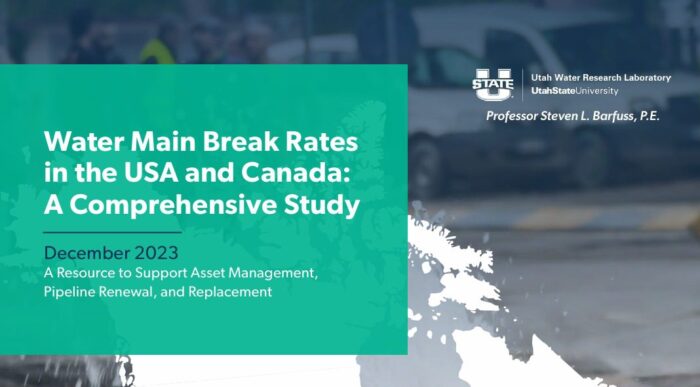
Study Says Lack of Funding for Critical Water Mains is $452 Billion
Over 800 utilities were surveyed and almost 400,000 miles of pipe data were analyzed, representing 17% of the estimated 2.3 million miles of water mains in the US and Canada. USU published similar studies in 2012 and 2018, and this report references them to analyze changes over time.
According to primary researcher Professor Steven L. Barfuss, P.E., one of the most important indicators for identifying failing pipelines is water main break rates. “Utilities can use this report to assist with asset management and facilitate water infrastructure planning and pipe replacement decision-making. The goals are to control operating costs, reduce service level impacts, and minimize health risks to customers,” says Professor Barfuss.
“Notably, the report shows that 20% or 452,000 miles of water pipes in the US and Canada are beyond their useful lives and need to be replaced but have not been due to lack of funds. This represents a $452 billion shortfall. In 2012, utilities reported that only 8% of installed water mains were beyond their useful lives, so this is a growing problem,” Professor Barfuss adds.
Major Findings and Benchmarks:
- The US and Canada experience 260,000 water main breaks annually, representing $2.6 billion in annual repair costs.
- Utilities reported the average failure age of water pipe is 53 years. Notably, 33% of water mains are over 50 years old, representing 770,000 miles of piping.
- In 2018, cast iron and asbestos cement together represented 41% of all installed water mains. In 2023, the combined length for these materials is 33%, a reduction of almost 8%. PVC pipe length increased by 7% and ductile iron remained approximately the same.
- Material usage varies significantly across geographic regions, suggesting that selection of pipe materials is often based on preference.
- A total of 86% of cast iron pipe is over 50 years old and 41% of asbestos-cement pipe is more than 50 years old.
- The estimated average water loss to leakage is 11%.
- Overall failure rates decreased by 20% since 2018, correlating with reduced inventory of cast iron and asbestos cement pipe, both of which have the highest break rates.
- A reconfirmed major finding is that PVC pipe has the lowest break rate when compared to cast iron, ductile iron, steel, and asbestos cement pipes.
- Almost 86% of water pipes in the US and Canada are less than 12 inches in diameter.
- Smaller pipes (12-inch in diameter and less) fail five times more than larger pipes (14-inch and larger).
- A total of 75% of utilities reported corrosive soil conditions, demonstrating the importance of corrosion mitigation for water pipelines.
- Ductile iron pipe has over six times more failures in highly corrosive soils compared to low corrosive soils.
- The percentage of utilities approving ductile iron has decreased by 8% from 86% in 2018 to 78% in 2023. Steel pipe has shown a 6% increase in acceptance from 38% to 44%.
- Almost 44% of utilities conduct some form of regular condition assessment of water mains.
To view the full report, including the full set of key findings and its methodology, click here.
Steven L. Barfuss, P.E., is a Research Professor at USU in the Civil and Environmental Engineering Department and an Associate Director at the Utah Water Research Laboratory (UWRL), a world-renowned water research facility. Professor Barfuss has over 37 years of research experience at UWRL and has published numerous peer-reviewed articles in national and international journals. He also has considerable experience in the hydraulics of pipelines and pipe failures.