New Technical Document Describes Development of ASTM F876 and History of PEX Success
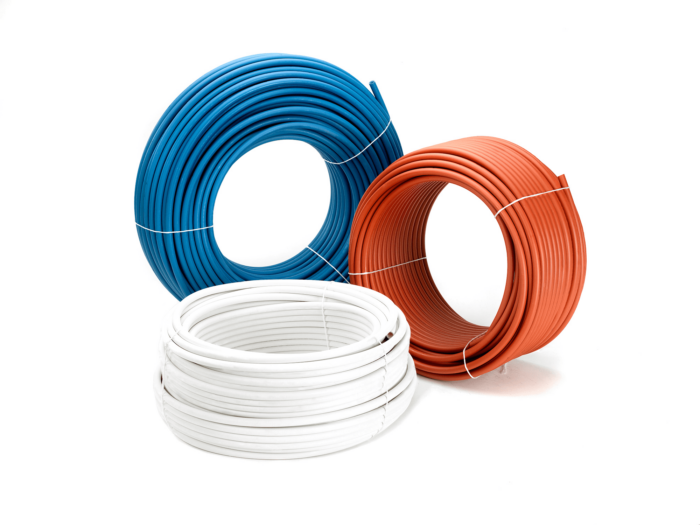
Coils of PEX tubing. Photo courtesy of PPI member company REHAU.
Forty Years of PEX Use in North America Documented as an Important Industry Reference
IRVING, Texas – Sept. 15, 2025 – The Plastics Pipe Institute, Inc. (PPI) has published a new technical report – TR-56 – that describes the history of crosslinked polyethylene (PEX) tubing in North America. Detailed are its start in Europe, the development of important industry standards, adoption into codes, and the widespread acceptance into North American plumbing and mechanical markets. According to the group, the report and the historical information it contains is a key industry resource.
Now available on the PPI website, PPI TR-56 “History of Crosslinked Polyethylene (PEX) Tubing in North America and the Evolution of ASTM Standard Specification F876 from 1984 – 2024” focuses on the development and evolution of this foundational ASTM Standard and lists revisions made in each new edition during the past forty years.
According to PPI, crosslinking technology for polyethylene was pioneered in Europe in the late 1960s, with the first PEX radiant heating systems installed in 1972. Since then, PEX has had a fifty-year history of successful use around the world for a variety of demanding applications.
“North American standards ASTM F876 and ASTM F877 were first published in 1984.”, stated Lance MacNevin, P. Eng., director of engineering for PPI’s Building & Construction Division. “ASTM F876 contained the primary requirements for PEX tubing itself, while F877 contained performance requirements for fittings to be used as a system with PEX tubing. These standards have evolved to include many new requirements for tubing, such as chlorine and UV resistance, and for fitting systems to ensure that connections are as strong or stronger than the tubing itself.”
ASTM F876 is the Standard Specification for Crosslinked Polyethylene (PEX) Tubing and ASTM F877 is the Standard Specification for Crosslinked Polyethylene (PEX) Hot- and Cold-Water Distribution Systems.
To gain a full perspective on the history of PEX, PPI interviewed Tomas Lenman, the piping engineer from Sweden who led the development of these standards and shared his story. The association also acquired copies of each edition of F876 and chronicled its evolution during its forty years. TR-56 includes a timeline of every revision made to F876 from 1984 to 2024 including new sizes, new tests, and more.
Within North American model plumbing codes, PEX was first included in the BOCA National Plumbing Code of 1993, the National Plumbing Code of Canada in 1995, the SBCCI Standard Plumbing Code (forbearer of the ICC International Plumbing Code) in 1997, and the IAPMO Uniform Plumbing Code (UPC) in 2000. Several other PEX standards are based on the requirements and test methods used within F876, including CSA B137.5, first published in 1989, and AWWA C904, first published in 2006.
PPI reported that the North American PEX industry is thriving in both residential and commercial construction, with PEX being the dominant material used in residential hot- and cold-water plumbing and in hydronic radiant heating/cooling systems. According to PPI estimates, more than 30 billion feet of PEX tubing has been shipped into Canada, USA, and Mexico during this period of exceptional growth. This is due mainly to the product’s ease of installation, reliable joining systems, and outstanding durability.
MacNevin continued, “ASTM F876 has provided guidance to manufacturers, certifiers, code officials, system designers, installers, and end-users about the capabilities of PEX tubing systems, helping to foster growth and responsible use of PEX materials. In 2024, it felt like this was the time to record the first forty years of history in one document, as an industry resource.”
Founded in 1950, PPI is the non-profit North American trade association representing the plastic pipe industry, including pressure pipe materials CPVC, HDPE, PEX, PE-RT, and PP. PPI members work together to develop industry publications, collaborate on standards, and create educational information about these systems.
The new PPI TR-56 is available directly by scanning:

Additional information about PEX and other plastic pressure piping systems is available from the PPI Building & Construction Division at www.plasticpipe.org/buildingconstruction
About PPI:
The Plastics Pipe Institute, Inc. (PPI) is the major North American trade association representing the plastic pipe industry and is dedicated to promoting plastic as the materials of choice for pipe and conduit applications. PPI is the premier technical, engineering and industry knowledge resource publishing data for use in the development and design of plastic pipe and conduit systems. Additionally, PPI collaborates with industry organizations that set standards for manufacturing practices and installation methods.