A Glass Seawall in Florida Balances Function with Aesthetics
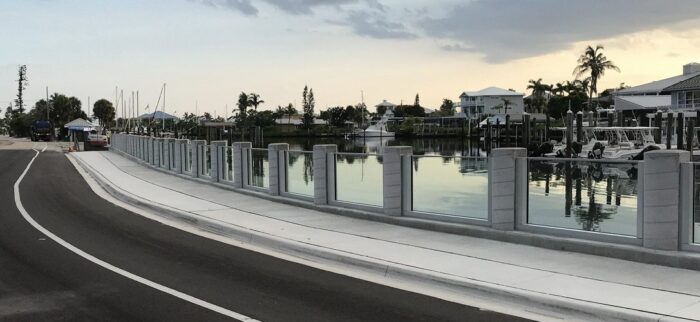
Venice, Fla., reconstructed its seawall using a glass floodwall. (City of Venice)
Florida’s Gulf Coast is beloved by its residents and visitors, but its attractive shoreline can take a beating from severe weather events.
In Venice, Fla., an existing seawall had reached the end of its useful life and needed to be replaced. During very high tides and large storms, water would overtop the seawall and flood the adjacent roadway, notes Christopher F. Kuzler, P.E., managing principal/director for Ardurra, the engineer of record for the project.
“Replacing the seawall, therefore, provided an opportunity to also raise its top to hold back water and reduce roadway flooding,” he adds. “However, raising the top of the wall would block residents’, motorists’ and pedestrians’ view of the water. Therefore, constructing a glass floodwall on top of the new seawall was chosen to meet the need for flood protection while also maintaining aesthetics and the view of the water.”
The Tarpon Center Drive Nature-Based Flood Mitigation Pilot Project includes replacing approximately 400 linear feet of the existing seawall along Tarpon Center Drive that was damaged by Hurricane Idalia in 2023. The total project cost is approximately $3 million. The project is being partially funded by a $1,575,000 Florida Department of Environmental Protection (FDEP) grant.
Anatomy of a Seawall
Designing a seawall involves multi-disciplinary coordination across structural, geotechnical, hydraulic and architectural domains, Kuzler points out.
“Seawalls are typically constructed of reinforced concrete panels or steel or fiberglass reinforced plastic (FRP) sheet piles driven deep enough into the soil to withstand the force of the soils and dynamic loads from cars and trucks on the landward side and the wave action and hydrostatic forces on the water side,” he adds.
A seawall typically is capped with concrete and has a series of anchors (tiebacks) driven into the soil behind the wall. Crushed rock often is installed behind the wall with screened weep holes through the wall to allow groundwater trapped behind it to seep out, thus reducing the hydrostatic load. The design engineer needs to calculate the expected loads on both sides of the wall and consider the soil properties to determine the proper depth of the wall and tieback requirements.
Venice chose a glass floodwall, which consists of laminated, tempered glass panels with stainless steel or aluminum framing installed between concrete columns. The thickness of the glass as well as the frame and concrete column designs need to consider the expected hydrostatic and hydrodynamic water loads, hurricane-force wind loads and impact loads from flying debris.
“For aesthetic reasons, if the top of the seawall cap isn’t level, the glass wall is usually installed on top of a concrete curb with a varying elevation, so the top of the glass wall remains level, which is much more appealing to the eye,” adds Kuzler.

The new seawall maintains waterfront views, increases safety and enhances public space. (City of Venice)
Design Considerations
The exposed front of the seawall and the glass floodwall must be designed to withstand not only the hydrostatic weight of water against the face of the wall but also wave and surge forces dictated by ASCE 7 and FEMA guidelines. Dynamic analysis also may be required for wave impact and overtopping scenarios.
Geotechnical investigations were conducted before design to determine the soil-bearing capacity and settlement potential. The seawall then was designed structurally to withstand soil and vehicle loads behind the wall as well as potential differential settlement. To ensure the glass floodwall and seawall acted as a unified system under load, structural models were developed, and concrete and reinforcement were designed to properly distribute the loads.
Groundwater will accumulate behind the wall and impose additional loads if not allowed to drain, notes Kuzler, adding that the design includes a drainage layer of crushed rock behind the wall that allows water to flow laterally and discharge out through weep holes.
Building a Seawall
The building process, conducted by Tampa Bay Marine, consisted of first relocating water and sewer lines behind the existing seawall. Next steps included excavating behind the seawall, removing the existing concrete seawall panels one at a time, vibrating in the new FRP sheet piles in the same location, and installing temporary anchors for the new FRP sheet piles. Following installation of the new FRP sheet piles, crews poured new concrete anchors behind the wall, installed tiebacks from the new wall to the anchors and removed the temporary anchors.
Workers then excavated and installed the crushed stone drainage layer behind the wall, followed by a soil backfill. Next came pouring the new concrete cap, sidewalk and curb for the new glass wall, which was followed by constructing the new concrete columns for the glass wall and then installing the glass panels with precision-mounted and engineered brackets and seals. Finally, crews installed sealants around the glass panel frames.

Crews install the glass floodwall, which consists of laminated, tempered glass panels with stainless steel or aluminum framing installed between concrete columns. (City of Venice)
Additional Challenges
“Permits and/or exemptions were required from the Florida Department of Environmental Protection (FDEP) and the U.S. Army Corp of Engineers (USACOE),” notes Kuzler. “To avoid permitting delays and meet grant funding deadlines, an FDEP exemption was obtained that required the new seawall be no more than 18 inches more seaward than the existing wall. The USACOE had very specific construction conditions—including no hammering of piles—to protect marine life.”
Another challenge: the southern portion of the project, near a roadway, was determined during design to be in an Area of Potential Effect listed or eligible for listing on the National Register of Historic Places due to prior habitation by Native Americans. This required archeological monitoring during construction to record if cultural artifacts were unearthed during construction (no artifacts were ultimately found).

The glass floodwall had to meet ASCE 7 and FEMA floodproofing standards. (City of Venice)
To maintain traffic flow during construction, crews closed one half of the road at a time and provided detailed signage, barricades and temporary striping to safely and efficiently guide motorists through the construction zone. New water and sewer mains were constructed before relocating the existing mains so services could be systematically transferred before deactivation, avoiding utility disruptions to residents and businesses. The existing seawall panels were removed and replaced one at a time, using earthen berms to avoid flooding the excavation behind them.
Crews also needed to confirm that the glass wall, concrete curb and columns were constructed at the proper elevations to keep the top of the seawall level using precise surveying techniques.
“Installing the glass panels requires special equipment and careful handling to avoid cracks or misalignment,” adds Kuzler. To mitigate this challenge, crews applied proper sealing around the glass wall frames using an elastomeric joint sealer resistant to seawater and capable of withstanding the hydrostatic loads while also expanding and contracting due to temperature variations.
The Wall They Wanted
Despite the challenges, the glass floodwall approach was chosen because compared to berms, levees or opaque floodwalls, it’s space-efficient and ideal for constrained urban environments. “It also preserves aesthetics and property value while functioning as both a flood barrier and a public guardrail system,” adds Kuzler.
It also offers resilience—in this case, the capacity to withstand and recover from extreme weather events such as hurricane-force winds and flooding.
“The wall has been designed to withstand the forces imposed by current building code wind speeds as well as impacts from flying debris,” says Kuzler. “The wall is also designed to withstand floodwaters and reduce flooding on Tarpon Center Drive, which is a designated evacuation route.”
The wall’s construction materials were selected for long-term exposure to saltwater, wind and debris. Through time, the modular glass panels can be replaced or upgraded as needed to adapt to changing conditions.
In addition to these approaches, the Venice municipal government notes that the project will include installation of reef balls to create vital habitats for fish, oysters, plants and other marine species. In addition to supporting marine biodiversity, these structures also help protect the seawall by reducing wave action.
Water and wastewater service will be improved along the seawall by installing new water services to adjacent buildings and replacing older sewer lines under Tarpon Center Drive. Remaining seawall project construction includes repaving and restriping the roadway in the vicinity of the seawall to provide an expanded bike lane and single lane of traffic in each direction. The remainder of the Tarpon Center peninsula roadways will be repaved and restriped at the conclusion of the upcoming utilities department’s water-main replacement program.
Ultimately, the benefit is that the glass floodwall meets or exceeds FEMA and local flood-elevation requirements and will reduce flooding of the roadway while maintaining waterfront views, increasing safety and enhancing public space.
“Plus, it supports tourism and community pride by making the waterfront a more enjoyable place to visit,” Kuzler points out.

About Carol Brzozowski
Carol Brzozowski is a freelance journalist specializing in technology, resource management and construction topics; email: brzozowski.carol@gmail.com.