Trimble 2026 Industry Outlook
Data center construction boom will continue
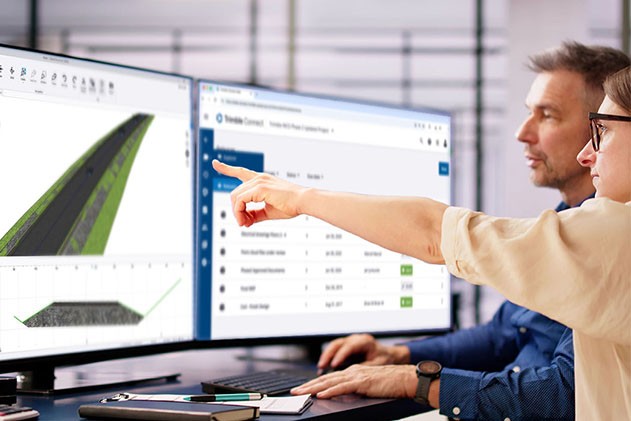
Data center development will continue to outpace traditional construction, demanding a new level of speed and precision. This relentless pace creates two distinct challenges for builders: coordination and confidence. A common data environment provides real-time information sharing, ensuring every team member is working from the same, most current plan. Advanced tools like 3D laser scanners and 3D modeling allow for pre-planning and conflict detection before anyone even steps on site, providing the confidence that the project will be executed flawlessly. By embracing and integrating technology solutions like these, builders can maintain control, mitigate risk, and meet the relentless pace of data center development head-on. – Duane Gleason, Industry Workflow Principal, Trimble
Artificial intelligence usage deepens
As the AECO industry deepens its use of artificial intelligence (AI), we’ll see a significant rise in the adoption of agentic AI systems — systems that can utilize GenAI and automate end-to-end processes. These systems will observe their surroundings, plan actions, reason, make decisions, and refine their strategies over time. In 2026, isolated pilots will move beyond experimentation to impact real-world workflows. Networks of AI agents will operate across design, engineering, and construction in connected ecosystems — streamlining design processes, orchestrating schedules, resolving conflicts, tracking progress, managing resources and more.
This evolution underscores the critical role of data interoperability, enabling seamless connection and data sharing across systems. At scale, interoperability will empower AI agents to work collectively and deliver measurable value throughout the project lifecycle — extending beyond construction into operations and maintenance.
Ultimately, this transformation will help the industry address labor shortages by freeing professionals to focus on strategy, creativity, and decision-making, while AI agents accelerate workflows, reduce waste, and unlock efficiencies that were previously impossible. – Aviad Almagor, Vice President of Technology Innovation, Trimble
Technology and training will be key to attracting the next generation workforce
According to numerous estimates, the construction industry will need to attract nearly half a million new workers in 2026 alone just to keep up with anticipated demand. The growing workforce shortage threatens project timelines, costs, quality, and overall industry growth. With nearly a quarter of the construction workforce set to retire in the next decade, the need to bring in younger workers has never been more urgent. Contractors that invest and deploy the latest technology will have a competitive advantage, by optimizing employee productivity and being able to do more with less. In addition, training programs that combine hands-on experience with cutting-edge digital tools, will upskill today’s workforce and attract tomorrow’s builders. The future of the industry depends on the ability to embrace technology and modernize our approach to talent development. – Ian Warner, Director of Industry Workforce Development & Innovations, Trimble
Adoption of subscription model will continue to grow
In 2026, the construction hardware and software subscription model is expected to see significant maturation, with a focus on more refined and comprehensive programs. These subscription services will offer increased flexibility and scalability, allowing contractors to customize offerings to their specific needs while benefiting from lower upfront costs and more predictable ongoing expenses. Providers will continue to enhance cloud-based solutions, offering more robust cybersecurity and ensuring automatic access to the latest technological advancements. This evolution will transform the relationship between providers and contractors into a more collaborative partnership, offering personalized support and strategic alliances to maximize efficiency and productivity. Ultimately, the model will help standardize operations and technology across organizations, ensuring all employees are working with the most current tools. – Toni Piwonka, Associate Vice President of Strategic Transformation, Trimble
Reality capture technology will become more democratized
Reality capture technology is already invaluable for precision, safety and speed, but will become even more democratized in 2026. New user-friendly tools will enable even more comprehensive data collection and in-field treatment for faster and improved decision making, as well as capture from mobile phones and robust mobile mapping systems. Reality capture is also becoming an integral part of project management workflows, enabling contractors to visually track progress, quickly identify issues and collaborate on solutions in real time. Enhanced by AI, machine learning and cloud-based platforms for sharing and collaboration, this rich spatial data will not only improve contextual information but also serve as a common visual language for all stakeholders to align efforts across projects and reduce misunderstandings. – Arnaud Lezennec, Senior Applications Engineer, Trimble
Evolution of task automation and autonomous machines continues
The path to autonomy in construction is an evolution more than a revolution, and that evolution will continue in 2026. We expect to see continued advancements across the industry in what will be the foundation to a future in which tasks and machines are more automated. Part of that foundation includes greater interoperability between machine types and technology providers, both of which should see forward movement in the coming year. Data is another key to unlocking true autonomy, and we expect to see the industry increasingly leverage vast datasets to create a more comprehensive understanding of construction jobsites. Connected, cloud-based ecosystems remain important for sharing and leveraging data for increasingly automated tasks, workflows and machines.
AI will also continue to mature and provide further productivity gains, improving the efficiency of both operators on machines as well as site foremen responsible for the overall delivery of the project. Current generation machine control systems will continue to penetrate the market and become table stakes for any modern earthmoving project.
Research and development, including from third-party developers and integration partners, will focus on automating individual tasks that deliver immediate value, including around site safety and operator productivity. – Ian Welch, Director of Engineering, Civil Construction Field Systems, Trimble
Rapid adoption of common data environments
Every construction company today is a data company and this reality is fueling the rapid adoption of common data environments (CDEs). CDEs are critical because they minimize time contractors waste trying to search for information, a vast majority of which goes unanalyzed and unused. CDEs eliminate this inefficiency by consolidating critical data from design, engineering, fabrication, construction, and maintenance into a secure, accessible hub. With a single source of truth, teams can collaborate in real time, improving visibility, accelerating decisions and driving project success. Beyond efficiency, CDEs also bridge the gap between physical and digital construction data, enabling the development of digital twins that enhance planning, design, construction and ongoing operations. By replacing silos and fragmented workflows with a unified, reliable flow of information, CDEs transform data into actionable intelligence across the entire project lifecycle. – Chris Peppler, Vice President of Platform and Product, Trimble
Data integration/interoperability efforts will accelerate
The complexity of modern construction projects makes it challenging to share data across diverse projects and teams, as stakeholders often rely on different technology stacks. Interoperability—the ability for data to flow seamlessly between software systems—ensures that every stakeholder can access the same information within their preferred tools. In the year ahead, construction technology vendors, including Trimble, are expected to accelerate efforts to enhance interoperability, delivering greater value to contractors. This includes building workflows and integrations between construction technology ecosystems, providing more opportunities for construction teams to share project data regardless of the various software deployed for a given project. Similar progress is underway in fleet interoperability on the jobsite, and in 2026 we expect that it will continue to become easier for contractors with mixed fleets to purchase, integrate and utilize technology more seamlessly. – Chris Peppler, Vice President of Platform and Product, Trimble
Smarter, GIS-centric infrastructure and asset lifecycle management
Municipalities, state agencies and private asset owners are facing a growing challenge of managing and maintaining vast, aging infrastructure as well as increasingly large and complex new construction projects with increasingly limited resources. Fortunately, innovations in 3D GIS and modeling technology are creating richer, more precise models of public assets. Concurrently, GIS-centric asset lifecycle management (ALM) is being redefined by AI, real-time spatial insights and secure data sharing. The result is easier real-time collaboration, smarter decision making, reduced risk and enhanced efficiency throughout every stage of an asset’s lifecycle.
Asset owners are recognizing that data gathered during the planning and construction phases is hyper-valuable for decades. As much as 75% of an asset’s total cost of ownership is accrued during the operations and maintenance phase. Also, GIS data helps assess performance degradation over time and pinpoint where maintenance is required. These capabilities are driving a shift from reactive to predictive maintenance, which can reduce costs by as much as 40%.
The advancement of digital technology is creating greater operational resilience, improved sustainability and, ultimately, better stewardship of taxpayer dollars. – Chris Bell, Vice President, AECO Industry Strategy & Product Marketing, Trimble
Purchasing and operability advances will extend cutting-edge technology to smaller contractors
While advanced, integrated technology is becoming more and more vital to competitiveness, barriers to entry are falling, and adoption by small and mid-size contractors will accelerate. The proliferation of subscription and SaaS options for both hardware and software will reduce upfront costs. Ongoing improvements in operability and user interfaces will further minimize the in-house IT expertise and support required for implementation, training and optimization of technology. For many software applications, e-commerce purchasing and versions with tiered capabilities and pricing will create opportunities for smaller companies to get started and then scale as they succeed and grow. Also, expanding opportunities to add solutions for multiple workflows from a single supplier will provide built-in integration and make it easier to manage technology stacks. – Doug Seyler, Vice President of Implementation and Customer Success, Trimble
In 2025, Trimble introduced authorized resellers representing a wide variety of manufacturers to its distribution channel, making it easier for mixed fleet customers to purchase, install and utilize the company’s grade control and site positioning technology. This expanded dealer channel means customers have access to Trimble technology, installation and support for equipment brands including John Deere, Komatsu, BOMAG, Wacker Neuson and more, all from their local dealer. As this accessibility continues to grow, look for it to also fuel a new level of data integration and interoperability between different equipment brands in 2026 and beyond. – Ron Bisio, Senior Vice President, Trimble Field Systems.
Visualization and 3D models/BIM for improved collaboration
Advances in collaboration tools and common data environments (CDEs) are transforming how projects are designed, built and operated. Increasingly, design conversations will take place directly within 3D models, enabling quicker iterations, faster workflows and stronger alignment throughout design and construction. As discussions are centralized, designers and other stakeholders can provide context, resolve questions and make decisions in real time. This collaboration-first approach extends into construction and operations where CDEs provide consistent access to documentation, context and visualization. With data easily shared, managed and updated, owners benefit from seamless digital handoffs at project completion, receiving rich data sets that inform long term asset management. Collectively, these advancements are streamlining critical workflows and helping stakeholders move from concept to reality with greater speed, clarity and confidence. – Sandra Winstead, Senior Director of Product, Architecture & Design, Trimble
More focus on comprehensive, integrated financial management capabilities
Financial management is critical in construction due to the complexity, resource intensity, and time-sensitive nature of projects. Process inefficiencies, lack of access to information and lag times or inconsistencies in the transfer of data across applications can lead to cost overruns, delays, misallocated resources and even project failure. To address this, contractors are increasingly adopting comprehensive enterprise resource planning (ERP) solutions. These systems offer construction-specific accounting functions integrated with vendor and subcontractor payment management, performance and compliance tracking, timekeeping, and HR capabilities—enabling contractors to better manage job costing, budgets, cash flow, and personnel, while enhancing overall profitability. As these solutions evolve, they are increasingly integrating with project management and material procurement tools, a development made even more crucial by uncertainties in tariffs and material pricing. – Jon Fingland, Vice President & Category Manager of Finance, HR, Project & Operations Management, Trimble