Relief in Sight: South Florida’s Long-Awaited I-95/SW 10th Street Connector
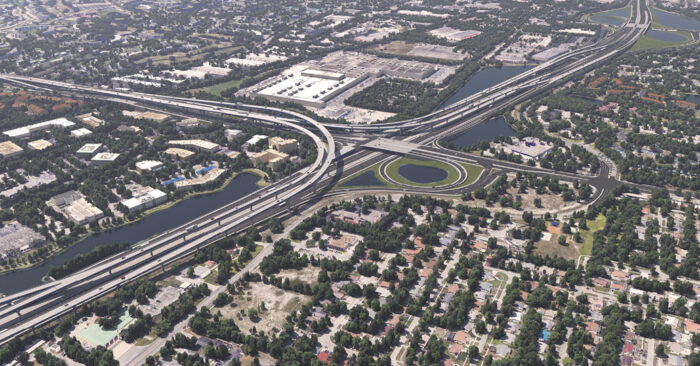
This FDOT District Four project will enhance the safety and efficiency of the SW 10th Street and I-95 corridors as well as deliver congestion relief. (WSP in the U.S. rendering)
For the team rebuilding the frustratingly congested Interstate 95 (I-95)/SW 10th Street corridor in Deerfield Beach, Fla., this is more than just another job: it’s definitely personal.
“We all have encountered heavy traffic along this highway, and for some of us it’s a daily nuisance,” explains Santos Valladolid, P.E., vice president of operations at Florida-based Prince Contracting. “So it’s gratifying to be part of a team that understands the problem from personal experience and will be tireless in finding the right solutions.”
After nearly four decades of planning and preparation, the Florida Department of Transportation (FDOT) is moving forward with construction of the $1.3 billion I-95/SW 10th Street Connector Interchange, a transformative infrastructure project that promises to untangle one of South Florida’s most notorious traffic knots.
The SW 10th Street Connector Project is one of more than 20 infrastructure projects launched as part of the Moving Florida Forward Initiative, a statewide program aimed at expediting Florida transportation projects to improve infrastructure, reduce congestion and enhance safety.
Let’s start with the basics: SW 10th Street in Deerfield Beach is an east-west roadway that’s used extensively by residents living in communities located along the corridor.
However, this relatively short stretch of roadway has been performing double duty as a segment of the Sawgrass Expressway (State Route 869) between Florida’s Turnpike (State Route 91) and (State Road 9) I-95, making it an essential route for freight traffic.
Understandably, this situation has led to daily bumper-to-bumper congestion, safety concerns and a lot of frustration for residents and regional vehicles just passing through Broward County.

Project Area Map
Fixing the Frustration
FDOT District Four is addressing the problem with the reconstruction of approximately three miles of the north-south I-95 highway from the Hillsboro Canal in the north down to Sample Road (State Route 834). It will add regional connectivity and provide greater capacity with an additional northbound and southbound express lane to complete the busy corridor.
For this phased design-build (PDB) project, FDOT District Four placed its trust in a joint venture (JV) that includes Prince Contracting LLC, part of the FlatironDragados group within the global ACS Group; OHLA USA, a division of the Spain-based construction company and WSP in the U.S., which is the lead designer.
A separate corridor project led by Archer Western that’s running concurrent to the I-95 reconstruction will improve a three-mile stretch of SW 10th Street between Florida’s Turnpike (State Route 91) and Newport Road near I-95 that was never designed to handle the volume or complexity of today’s traffic.
In the new configuration, SW 10th Street Connector Lanes will serve regional traffic, providing a direct, limited-access link as the Sawgrass Expressway between Florida’s Turnpike and I-95. A separate local SW 10th Street will be transformed into a “complete street” with a 12-foot-wide shared-use path for pedestrians and cyclists, landscaped buffers, enhanced lighting, lower speed limits (35 mph on local lanes) and improved access to local properties.
“The primary objective of the entire connector project is to separate local traffic from highway traffic and return local roads to residents,” notes Yamila Hernandez, P.E., senior vice president at WSP and dedicated design manager. “This will greatly improve mobility along nearby local roads.”

An FDOT rendering shows green space and a shared-use path to the south of local SW 10th Street near SW 28th Avenue.
Local Chemistry
The JV and WSP are responsible for all aspects of the project except for the Archer Western-led segment. The JV’s portion of the job along I-95 will reconstruct the four-level interchange at SW 10th Street, widening the corridor to create a second express lane that Hernandez says is “the missing link within the 95 Express corridor, alleviating congestion and creating predictable times for motorists.”
The project also encompasses the reconfiguration of the I-95/SW 10th Street Interchange with direct connection ramps from NB and SB I-95 Express and general-purpose lanes to the SW 10th Street Connector to and from the west; ramp and terminal intersection improvements for the I-95/Hillsboro Boulevard interchange; and replacement of the I-95 bridges over Hillsboro Boulevard and the NW 48th Street bridge over I-95.

An FDOT rendering of the SW 10th Street Connector/I-95 Interchange, looking west.
From east to west, the JV is responsible for work on SW 10th Street from Newport Center Drive to Natura Boulevard.
“This team was selected to meet the needs of a PDB delivery: personnel selected with a history of collaboration, trust, innovation and agility to adjust to the process as it evolves,” notes Yonathan Benarroch, vice president of operations for OHLA. “We bring a proven ability to adapt to changes, resolve issues and provide innovative solutions that improve the project design and constructability, while delivering projects on-time and within budget.”

The SW 10th Street Connector at Newport Center Drive, looking north.
“It’s the chemistry of this team—with its significant local knowledge and FDOT experience, history of working together and extensive resources—that makes the difference,” adds Hernandez. “We could see that in action from the get-go.”
The team has co-located to a permanent office near the worksite, where each participant will leave their respective company hats at the door and operate as one organization focused on a unified purpose: maximizing the project scope to add capacity; improve regional connectivity; and enhance safety, efficiency and mobility for the corridor.
“The experience that this team brings to this type of phased design-build approach is substantial,” says Fernando Arranz, Prince project executive who serves as project manager for the JV. “This team is comfortable with each other and this method of project delivery.”
Smart Roads, Smarter Travel
This upgrade is about more than concrete, asphalt and bridge reconstruction. The project includes cutting-edge intelligent transportation systems (ITS). FDOT will implement advanced transportation systems management and operations (TSM&O) technology into the overall design.
While delays are anticipated during any road construction, TSM&O technology work, already underway, will help minimize disruptions. Real-time alerts about lane closures and congestion will use dynamic message signs and roadside units that communicate with mobile phones to warn motorists about congestion, pedestrians or construction zones. Alternate route suggestions will help motorists navigate detours while maintaining access to businesses and residences.

Permanent arterial ITS infrastructure along nearby north-south routes U.S. 1, Dixie Highway (State Route 811), Powerline Road and U.S. 441; and east-west routes Hillsboro Boulevard and Sample Road will be incorporated into a smart work zone system during construction of the SW 10th Street Connector and I-95 improvements. After construction, these networks will continue to provide long-term traffic management benefits to motorists. It will integrate into existing mobile apps, such as FDOT’s FL511, which provides real-time traffic information and alternate routes.
“The smart roads aspect of this project is significant,” notes Hernandez. “By leveraging smart technology and modern infrastructure solutions, we’re creating a holistic corridor that will adapt to technology changes and improve commuter experience and regional traffic efficiency for decades to come.”
FDOT is prioritizing construction sequencing to reduce the duration of work along local SW 10th Street, especially at key intersections such as Military Trail and Newport Center Drive. All local side streets and driveways are required to remain open throughout construction—with the exception of short-term closures for specific work directly at crossing points. Access to local businesses will be maintained throughout construction, with short-term closures communicated in advance.
After the planning phase is completed mid-January 2026, preconstruction is scheduled to follow, with construction expected to begin in 2026 and continue through 2032.
Procurement Innovation
Unlike traditional contracts that lock in rigid scopes and pricing early on, the PDB method deployed by FDOT for this project cuts through the red tape and allows for a less-restrictive procurement process that can adapt to sudden changes in the scope, supply availability or prices.
“It’s a procurement method that delivers best value—and it’s one the industry may increasingly adopt as infrastructure demands grow,” explains Arranz. “We have open conversations with the client at all times. There are some boundaries but not as many as before, so we are free to generate optimal decisions.”
This procurement strategy fosters a strong team dynamic and was part of an overall commitment by the design-build team to introduce cost-saving innovations into the overall project.
“We promised FDOT that during that innovation phase we would produce hundreds of ideas that would bring the budget down from the job and make it simpler, safer and faster to construct,” says Benarroch. “Some were big, and some were small. As of right now, we finished that first innovation process, and 99 percent of the ideas are approved and implemented into our concept plans, finding significant savings without sacrificing quality. It was what we promised, and we delivered.”
Environmentally Sound
The overall corridor design incorporates the following:
• Resilient infrastructure: Elevated roadways and improved drainage designed to withstand South Florida’s hurricanes and flooding.
• Noise mitigation: Decorative noise barrier walls will reduce traffic noise by up to 14 decibels for nearby communities.
• Sustainability: Materials and construction methods will be chosen for long-term durability and minimal environmental impact, ensuring that the corridor remains functional and safe during extreme weather events.
Several preventive actions will be in place during construction to mitigate environmental impacts, including dust prevention, monitoring and protecting endangered species as well as installing silt barriers around the project limits to prevent undesired soil migration.
Erosion control methods will be incorporated to replace the plants that normally provide natural erosion prevention for the soil in the area, and the installation of inlet protection elements will prevent construction debris from entering drains that flow to fresh water.
Public Approval
FDOT didn’t design this project in a vacuum. Local resistance to a long and disruptive construction process was the key factor in the long delay in starting this project. Extensive community engagement was undertaken that involved hearing the concerns and implementing solutions to those concerns, shaping a project that earned the eventual support of the community.
Public input from residents who are impacted every day by the upgraded corridor were instrumental in informing designers about the scope of green spaces, aesthetic enhancements and the shared-use path that soon will be signature features of the overall design.
Nearly all the communities along the corridor qualified for noise barriers. Residents of neighborhoods such as Century Village East, Waterford Homes and The Enclave at Waterways were surveyed and voted overwhelmingly in favor of noise-barrier walls, which will be constructed in early 2026 as the first visible work for the corridor project.
FDOT will continue to involve the local community and the JV in conversations that will keep them apprised of progress and address any concerns that may arise throughout construction.

Designed for Life
“In addition to safety and quality-of-life enhancements, we’re confident that routing non-local traffic onto dedicated connector lanes will help reduce travel time at peak hours by up to eight minutes for local traffic and as much as 14 minutes for highway traffic over current times,” adds Hernandez. “That’s meaningful when you are trying to pick up your child at daycare or reach an appointment on time.”
The connector will boost freight mobility, efficiency and reliability, especially for distributors operating in Broward County.
“Above all else, it’s about connectivity—and not just for the roads and vehicles, but for people who live here,” notes Valladolid. “We are a really strong team, and the delivery method is exciting. To enjoy what we’re doing and serve our community at the same time is beyond satisfying.”
Watch an FDOT video of the project by visiting iimag.link/wnhfC


About Richard Reitz
Richard Reitz is editorial manager for WSP in the U.S.; email: Rick.Reitz@wsp.com.