Big Easy Upgrades Water System
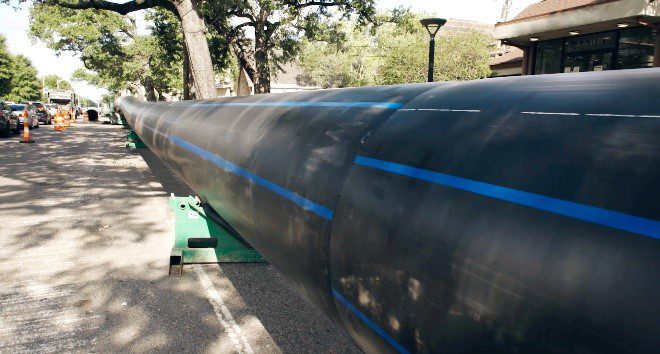
One Phase Completed, Saving Five Million Gallons Daily; Others Fast Tracked Due to Timesaving HDPE Pipe Installation Method
NEW ORLEANS – Being more than 300 years old, the Crescent City has had water transmission lines ranging from hollowed-out cypress logs to more traditional materials such as cast iron, asbestos concrete, and now, today’s leak-free high-density polyethylene (HDPE) PE 4710 pipe that allows for greater pressures, while providing a greater hydraulic capacity, resiliency, cost effectiveness, water conservation, and installation efficiencies.
New Orleans’ aging infrastructure has led to numerous boil orders, unstable water pressure, plus damage to roads and pavement from water main breaks. To rectify those issues, the Sewerage & Water Board of New Orleans (SWBNO) launched an 11-project effort in 2023 to replace its cast iron potable water transmission mains with a modern piping system, stating that it was “using the HDPE pipe because it is more durable than traditional pipes.” The utility serves more than 138,400 customers with nearly 152 million gallons of water daily using 1,600 miles of water main.
The South Claiborne Transmission Main Project, one of the 11 now on the books, aimed to stabilize water pressure in many areas of the city and improve water quality with HDPE pipe that has a design life of 100 years. Completed in the fall of 2023, it has been reported that the new pipeline is saving New Orleans five million gallons of water a day.
Using CompressionFit™ trenchless installation technology and the HDPE pipe, it has been estimated by the contracting installer that there was an overall 25 percent savings in materials, labor and time compared to other methods.
“The South Claiborne Transmission Main project illustrates the value of PE 4710 HDPE pipe for cost-effective piping rehabilitation through CompressionFit,” explained Camille George Rubeiz, P.E., F. ASCE, co-chair, HDPE Municipal Advisory Board (MAB), and senior director of engineering for the Plastics Pipe Institute’s (PPI) Municipal & Industrial Division. PPI is the major North American trade association representing the plastic pipe industry.
The Transmission Main Program is FEMA-funded and managed by SWBNO in cooperation with the City of New Orleans as part of the Joint Infrastructure Recovery Roads (JIRR) Program. Total cost for the South Claiborne Avenue Transmission Main was budgeted at $25.5 million.
The Murphy Pipeline Contractor’s (Jacksonville, FL) CompressionFit method uses the old pipeline as a path for pulling through the new pipe. Governed by ASTM F3508, CompressionFit uses HDPE pipe with an outside diameter larger in size than the inside of the existing pipe. After the HDPE pipe sections are heat fused to the desired length, the monolithic pipeline is pulled through a reduction die before entering the old host pipe. This reduces the HDPE pipe temporarily below the inside diameter of the host pipe allowing it to be inserted.
Once the pipe has finished being pulled through the length of the section, the tension reduction allows it to expand, pushing flush against the interior of the existing pipe. This technique, especially for the South Claiborne Transmission Main Project, helped reduce overall project costs, minimize traffic disruption, and simplify the installation. It was also a key component for securing project funding. Murphy is a member company of PPI’s Municipal Advisory Board (MAB).
According to HDPE pipe industry expert and consultant Harvey Svetlik, P.E. “One of the principal things that this technology does is that it preserves the flow rate of the existing host pipeline and seals over holes and leaks, so you have a dual-wall composite pipeline. And the thicker HDPE pipe provides structural integrity.” The wall thickness of the DR 17 HDPE pipe is 2.9 inches and is rated to handle up to 125 psi. The city’s water transmission lines run 70 to 80 psi.
HDPE pipe, according to PPI’s Rubeiz, offers corrosion protection, flexibility, durability, and best seismic resistance than any other piping materials. “Moreover, it virtually eliminates leakage plus prevents any infiltration of sediment or rainwater into the system. The pipe also has a low biofilm formation potential, highlighting its capability to preserve water and water quality while conveying it,” he stated “Even the 48-inch diameter HDPE pipe with a wall thickness of nearly three inches is ideal as its properties align with the compressed fit installation method outlined in ASTM F3508.”
Two sizes of PE 4710 DIP SDR 17 pipes were used: 4,400 feet of 48-inch and 1,150 feet of 30-inch diameter. The pipe was manufactured by AGRU America at its Charleston, S.C. plant. AGRU pipe is available in sizes up to 11.5 feet (OD) and seamless lengths up to 2,000 feet long. It is a member company of PPI.
The South Clairborne job was voted Project of the Year by the Municipal & Industrial Division of PPI for the year 2023. Each year the PPI membership reviews and votes on the Project of the Year for each of the five PPI divisions. The award was presented to AGRU during the association’s annual membership meeting held in May 2024.
CMG Pipelines, Inc. (Kenner, LA) installed the pipe. “There’s not a lot of certainty about what’s in the ground in New Orleans. With directional drilling or digging trenches, who knows what you’ll hit,” explained CMG President Carmelo Gutierrez, P.E. “A lot of New Orleans is built on reclaimed land, using whatever they found that was cheap to throw in the hole is what they filled it up with. And when you start digging through that, it’s going to be a pain. The typical trench for 48-inch pipe required here in New Orleans would be eight feet wide and five feet deep to the top of the pipe. So, you’re eight feet wide, 14 feet deep for a thousand feet. Digging that is not fun. It’s horrible, horrible ground to dig in and tough. Plus, protecting our crew is most important. That’s also why we suggest HDPE, because of the soil here, and the settling that we have and the water table, and all the little issues that we have in New Orleans. HDPE solves those issues.”
During the 14-month long project, it took the CMG crew of 16 – two teams of eight – four months to actually install the pipe from South Claiborne and State Street to South Claiborne and Upperline Street. One team was at the entrance pit took care of fusion and moving pipe. The other one took care of prepping the holes and did the pull.
“We did 4,400 feet of 48-inch, nearly 1,200 feet of 30-inch, and some 8-inch open cut. Because we’re close to Tulane University, we had to watch their football schedules, and had to pay attention to traffic,” Gutierrez explained. “Our longest pull was about 1,400 feet through the old cast iron pipe. We had a couple of large control valves. We dropped one 48-inch valve and three 30-inch valves in the system to help control the flow.
“There were also sidewall fusions where we were able to use HDPE all across to do our tie-ins, plus, standard fittings, adapters and MJ adapters. That’s because of HDPE’s flexibility at normal ductile line pipe size, and we didn’t miss a beat. We had all the fittings we needed. Basically, one day the pipe was above ground and the next day it was gone.
“Compression allowed the city to fix their lines quicker,” he continued. “We didn’t have to worry now about the path of the pipe, because we followed the same path. It made an otherwise tough job fun. And the utility agreed that this was the most cost-effective and time-effective method to quickly replace their mains without creating so much mess in the city.
“We believe HDPE is the way of the future. It solves a lot of check marks for the concerns of utility companies, utility owners. That’s how Murphy Pipelines and CMG brought this technology to New Orleans, and SWBNO has added a new tool to its pipe replacement toolbox. Now, they’re rehabilitating large diameter lines, and a few years ago that was never a thought.”
More information can be found at www: plasticpipe.org/mabpubs
About PPI:
The Plastics Pipe Institute, Inc. (PPI) is the major North American trade association representing the plastic pipe industry and is dedicated to promoting plastic as the materials of choice for pipe and conduit applications. PPI is the premier technical, engineering and industry knowledge resource publishing data for use in the development and design of plastic pipe and conduit systems. Additionally, PPI collaborates with industry organizations that set standards for manufacturing practices and installation methods.