Trends April 2025
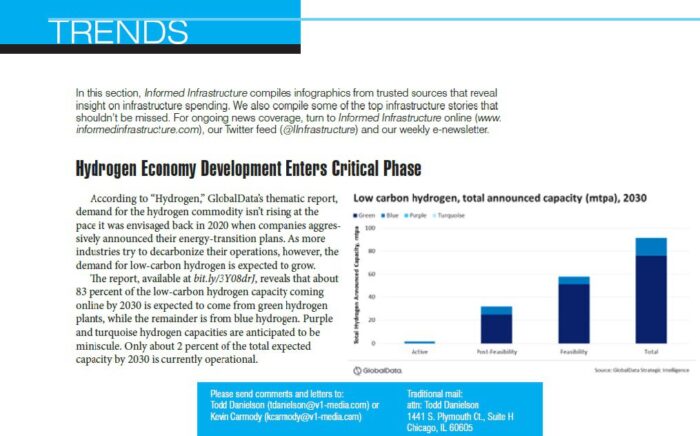
Hydrogen Economy Development Enters Critical Phase

According to “Hydrogen,” GlobalData’s thematic report, demand for the hydrogen commodity isn’t rising at the pace it was envisaged back in 2020 when companies aggressively announced their energy-transition plans. As more industries try to decarbonize their operations, however, the demand for low-carbon hydrogen is expected to grow.
The report, available at bit.ly/3Y08drJ, reveals that about 83 percent of the low-carbon hydrogen capacity coming online by 2030 is expected to come from green hydrogen plants, while the remainder is from blue hydrogen. Purple and turquoise hydrogen capacities are anticipated to be miniscule. Only about 2 percent of the total expected capacity by 2030 is currently operational.
Report Shows Large Decline in Traffic Deaths in Lower-Income Neighborhoods with Street Redesign

A new “Vision Zero” report from the New York City Department of Transportation revealed that predominantly lower-income neighborhoods that received street redesigns saw the largest declines in traffic deaths. Vision Zero began in 2014 to improve street safety through data-driven initiatives.
Communities of all incomes experienced declines in pedestrian fatalities and all traffic fatalities. However, lower-income neighborhoods that received more Street Improvement Project installations per mile experienced the greatest decline in pedestrian fatalities on average: decreasing 34 percent.
Read the full report at bit.ly/4iylb8n.
Research Analyzes Water Infrastructure Funding Gap

Across the United States, private and public water and wastewater utilities are underfunded. Research from McKinsey and Company shows the U.S. water utility sector faced an estimated $110 billion funding gap in 2024 (nearly 60 percent of utilities’ overall spending), primarily driven by significant investments in aging infrastructure, operating expenses and water-quality regulations. By 2030, researchers note, this gap could increase to approximately $194 billion.
McKinsey and Company’s analysis suggests that “state and local leaders can provide the operational, technical and financial assistance that the highly fragmented utilities landscape needs to solve these challenges.” This report, available at bit.ly/4kwVkiC, identifies 10 key actions state and local leaders can explore to help utilities close as much as 45 percent of the funding gap.
TOP Stories
The following are the top stories from the last few months (in terms of traffic) on the Informed Infrastructure website. This also reflects key coverage areas that are regularly refreshed online and via our weekly e-newsletter. Simply search key words on Informed Infrastructure online to find the full story.
Buildings
- Materials Compass by One Click LCA Opens the World’s Largest Product Carbon Database for Building and Infrastructure Designers
- American Concrete Institute Publishes Code Requirements for Low-Carbon Concrete
- Global Alliance Unveils New Report to Unlock Billions for Decarbonizing Buildings at Scale
- New Report from U.S. Green Building Council Details Data on Three Decades of Impact
- The Benefits of Adaptive Reuse: Giving New Life to Old Buildings, Reinvigorating Neighborhoods
Transportation
- Video: Wind River Canyon Centennial
- IFRA Issues $108M to State DOT Railroad Projects
- Acrow Bridge Supports Major Estuary Repair Project in Massachusetts
- STV-Naik Joint Venture Supports Comprehensive Modernization of Nation’s Busiest Rail Line
- HDR Experts Share How Airports Can Approach PFAS Contamination Concerns
Water
- Stantec Supports Multiple Southeastern Cities with Lead and Copper Rule Revisions Compliance
- City in Saskatchewan Modernizes Utility Operations Using Xylem Technology
- Desalination Is Booming, But Faces a Saltwater Reality Check
- New Report Exposes Alarming Economic Impacts on D.C. Region if Faced with Water Supply Disruption
- Energy Vision Primer Highlights Potential of Wastewater Plants to “Co-Digest” Food Waste, Produce Renewable Energy, and Help Meet 2030 Methane Emissions Goal
Tools and Technology
- New Bluebeam Research Reveals Growing AI Use in Construction, but Regulatory and Talent Challenges Persist
- Pushing Boundaries: Expert Insights on Offshore Structural Engineering
- Trimble Expands Access to Advanced Construction Project Management Capabilities with Free Version of ProjectSight Software
- How To Achieve 60% Faster Project Delivery with AI Rendering
- HCSS Announces Improved Takeoff Integration for HeavyBid Software